Marketing Symptoms vs Business Problems: Why Brands Fix the Wrong Thing
When marketing results are weak, brands often rush to fix what they can see.
Low engagement? Post more.
Low leads? Run ads.
Weak sales? Launch an offer.
Poor reach? Change the content format.
Outdated page? Redesign the visuals.
Sometimes these actions help.
But many times, they only treat the symptom.
They do not solve the real business problem underneath.
That is why marketing should start with diagnosis.
Because if you fix the wrong thing, you may become busier without becoming better.
What Is a Marketing Symptom?
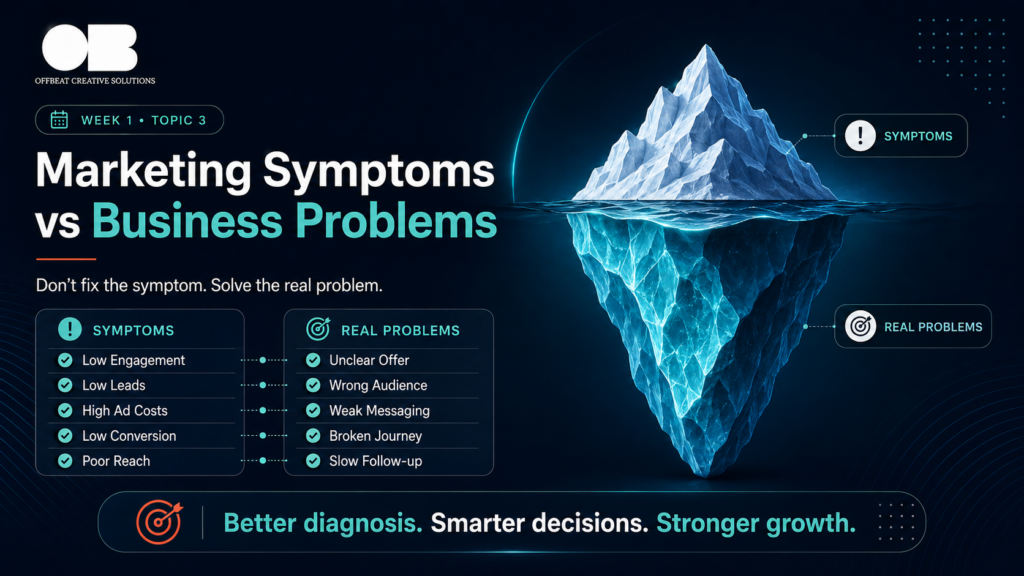
A marketing symptom is the visible sign that something is not working.
Examples include:
Low engagement
Low reach
Low leads
High cost per lead
High traffic but low conversion
Weak sales
Poor message response
Low website inquiries
Bad ad performance
Low customer retention
These symptoms are important.
But they are not always the root problem.
They are signals.
The job of a strong marketing diagnosis is to understand what those signals mean.
What Is a Business Problem?
A business problem is the deeper reason behind weak marketing results.
For example:
The offer may not be clear.
The audience may be too broad.
The positioning may be generic.
The customer journey may be confusing.
The landing page may not build trust.
The sales process may be slow.
The brand message may not explain enough value.
The content may not answer the right questions.
The business may be attracting the wrong type of leads.
When brands confuse symptoms with problems, they spend energy fixing surface issues.
But the root problem remains.
Low Engagement Is Not Always a Content Problem
When engagement is low, many brands think they need better posts.
That may be true.
But low engagement can come from many deeper issues.
The content may not speak to a clear audience.
The message may be too generic.
The topics may not connect to real customer problems.
The tone may not match the audience.
The brand may be posting without a content pillar system.
The audience may not understand why the brand matters.
So the solution is not always “post more.”
The solution may be to clarify the audience, sharpen the message, and build stronger content pillars.
Low Leads Are Not Always an Ads Problem
When leads are low, many businesses blame the ads.
They may think the targeting is wrong, the budget is low, or the creative is weak.
Sometimes that is true.
But low leads can also come from:
A weak offer
Unclear landing page
No trust signals
Poor call to action
Generic positioning
Wrong audience stage
Weak content before the campaign
Ads can bring people in.
But if the offer and journey are not strong enough, people may not take action.
Before increasing the budget, diagnose the full path.
High Traffic but No Conversion Is a Journey Problem
Traffic is useful only when the journey can convert it.
If people visit the website but do not contact the business, the issue may not be traffic.
It may be what happens after the click.
The page may not explain the offer quickly.
The headline may be unclear.
The proof may be weak.
The call to action may be hidden.
The website may not answer objections.
The user may not understand what to do next.
In this case, more traffic will not solve the problem.
It will only bring more people into a journey that does not convert.
Good Designs Do Not Fix Weak Positioning
Many brands believe that if the visuals look better, the brand will perform better.
Visual identity matters.
Design matters.
Presentation matters.
But design cannot replace positioning.
If people do not understand why the brand is different, better visuals may only make the confusion look more polished.
A brand needs to know:
What space does it want to own?
What makes it different?
What value does it provide?
What should the audience remember?
Why should people choose it?
Once positioning is clear, design can express it.
But design cannot create meaning alone.
Sales Problems Can Look Like Marketing Problems
Sometimes marketing generates leads, but sales does not convert them.
From the outside, it may look like marketing is failing.
But the real issue may be after the lead comes in.
The response may be slow.
The sales message may be unclear.
The team may not qualify leads properly.
Follow-up may be weak.
Objections may not be handled.
Sales feedback may not be shared with marketing.
If the sales process is broken, more marketing can create more missed opportunities.
This is why diagnosis should include sales.
Why Brands Fix the Wrong Thing
Brands often fix the wrong thing because surface problems are easier to see.
It is easier to say:
“We need more content.”
Than to say:
“Our positioning is unclear.”
It is easier to say:
“We need ads.”
Than to say:
“Our offer is not strong enough.”
It is easier to say:
“We need better visuals.”
Than to say:
“Our message does not explain our value.”
But real growth usually comes from solving the deeper issue.
How to Diagnose Before Fixing
Before choosing a marketing action, ask:
What exactly is not working?
Where is the drop-off happening?
Is the problem awareness, trust, conversion, or sales?
Is the offer clear?
Is the message specific?
Is the audience correct?
Is the journey smooth?
Is there enough proof?
Is sales follow-up strong?
Are we measuring the right thing?
These questions help separate symptoms from causes.
The Offbeat Approach
At Offbeat Creative Solutions, we do not treat marketing as isolated deliverables.
We look at the full business journey.
We diagnose the offer, audience, positioning, messaging, content, website, ads, and sales process.
Because weak results may not come from one single problem.
They may come from a disconnected system.
Our role is to help brands understand what needs to be fixed before deciding what needs to be created.
That is how marketing becomes more strategic, more focused, and more connected to business growth.
Final Thoughts
Not every marketing problem needs more marketing.
Sometimes the brand needs clearer positioning.
Sometimes it needs a stronger offer.
Sometimes it needs a better customer journey.
Sometimes it needs sales alignment.
Sometimes it needs a sharper message.
If the diagnosis is wrong, the solution will be wrong.
And if the solution is wrong, the brand may keep creating more activity without better results.
Marketing without diagnosis is just guessing with better visuals.
But marketing with diagnosis gives every action a reason.