Why Paid Ads Fail When the Brand Journey Is Broken
Paid ads often reveal problems faster than any other marketing channel.
A business may launch a campaign expecting leads, sales, bookings, or inquiries.
The ads start running. The budget is spent. People click. Traffic increases.
But the results still feel weak.
At first, the problem may seem obvious.
Maybe the audience targeting is wrong.
Maybe the creative is not strong enough.
Maybe the platform is too expensive.
Maybe the budget is too small.
These things can be part of the problem.
But many times, paid ads fail because the brand journey itself is broken.
The ad is only one step.
If what comes after the ad is unclear, weak, or disconnected, the campaign may struggle no matter how much money is spent.
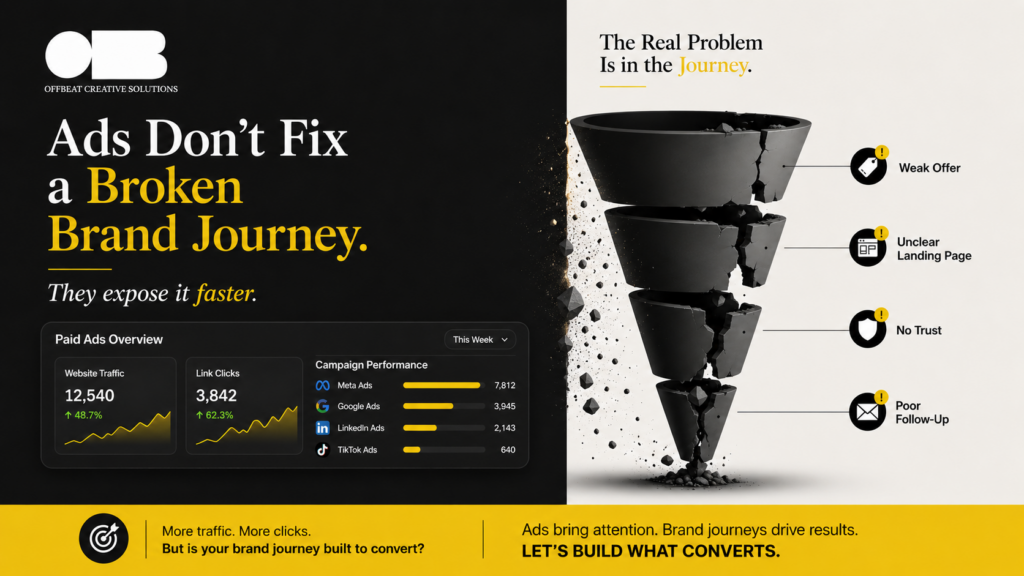
Paid ads do not hide weak journeys.
They make them more visible.
The Ad Is Only the First Step
A paid ad is not the full marketing system.
It is usually the first step in a larger journey.
The customer sees the ad.
Then they may visit the landing page.
Then they may check the website.
Then they may look for reviews or proof.
Then they may compare options.
Then they may submit a form, send a message, book a call, or leave.
Each step affects the final result.
If the first step is strong but the next steps are weak, the campaign will lose people along the way.
This is why campaign performance cannot be judged only by the ad account.
Clicks, impressions, reach, and cost per lead matter.
But they do not show the full picture.
To understand why paid ads are failing, businesses need to look at the full journey.
Message Mismatch Kills Performance
One common reason paid ads fail is message mismatch.
This happens when the ad says one thing, but the landing page or website says something else.
For example, the ad may promise a clear solution, but the landing page uses vague language.
The ad may focus on a specific problem, but the website talks generally about the company.
The ad may target a specific audience, but the page feels like it was written for everyone.
This creates confusion.
When people click an ad, they expect the next page to continue the same conversation.
If the message changes, trust drops.
A strong journey keeps the message consistent from the ad to the landing page to the sales follow-up.
The audience should feel that every step is connected.
Poor Landing Pages Reduce Conversion
A landing page can make or break a paid campaign.
Even if the ad generates the right traffic, the landing page has to convert that attention into action.
A weak landing page may have:
An unclear headline
Too many distractions
No strong call to action
No proof or testimonials
Slow loading speed
Weak mobile experience
Confusing structure
No clear offer
No reason to trust the brand
The landing page should quickly answer the visitor’s main questions.
What is this?
Is it for me?
Why should I care?
Why should I trust it?
What should I do next?
If these answers are not clear, people leave.
Paid ads can bring visitors to the page.
But the landing page has to earn the conversion.
Weak Brand Trust Increases Hesitation
Paid ads often reach people who do not know the brand yet.
That means trust is not automatic.
The audience may need proof before taking action.
This proof can come from testimonials, reviews, case studies, client results, portfolio work, certifications, team experience, process explanations, or clear contact information.
Without proof, the brand may feel risky.
People may hesitate even if they like the offer.
This is especially true when the service is expensive, the decision is important, or the market has many competitors.
Ads create visibility.
Trust gives people confidence.
A campaign with high visibility but low trust will usually struggle to convert.
A Weak Offer Creates Weak Results
Sometimes the campaign fails because the offer is not strong enough.
The audience may understand the message but still feel no urgency to act.
A good offer should be relevant, specific, valuable, and easy to understand.
It should match the stage of the audience.
Cold audiences may need education or a low-commitment step first.
Warm audiences may respond better to consultations, audits, demos, or direct service offers.
Returning customers may respond to upgrades, packages, loyalty offers, or new solutions.
If the offer does not match the audience, the campaign may attract attention but fail to create action.
Before changing the budget, businesses should check whether the offer is truly compelling.
Positioning Problems Show Up in Ads
Paid ads can also fail when the brand positioning is unclear.
If the audience cannot understand why the brand is different, they may compare it only by price or ignore it completely.
Positioning helps answer the question:
Why should someone choose this brand instead of another?
Without positioning, the brand message may sound generic.
The campaign may look like every other campaign in the market.
The landing page may fail to communicate a clear advantage.
The sales team may struggle to explain the value.
Strong positioning makes the entire journey sharper.
It gives the ad a stronger angle.
It gives the landing page a clearer message.
It gives content a more focused direction.
It gives sales a stronger reason to close.
Sales Follow-Up Affects Final Results
A campaign can generate leads and still fail if the follow-up process is weak.
Lead generation is not the same as sales.
Once a lead comes in, the business still needs to respond quickly, qualify the lead, understand the need, answer objections, and guide the customer toward the next step.
If the response is delayed, the lead may lose interest.
If the sales team does not know the campaign message, the conversation may feel disconnected.
If there is no clear follow-up process, opportunities may be lost.
This is why sales and marketing should work together.
Marketing should not only deliver leads.
Sales should also provide feedback.
Which leads were qualified?
What objections appeared often?
Which campaign produced better customers?
Where did people lose interest?
What questions did they ask before buying?
This feedback helps improve the ads, content, landing page, and offer.
Reporting Should Go Beyond the Ad Dashboard
Ad dashboards are useful, but they are not enough.
They show campaign activity.
They do not always show business impact.
A campaign may have good clicks but weak conversions.
Another campaign may have fewer leads but stronger customers.
That is why businesses should measure the full journey.
Useful metrics include:
Landing page conversion rate
Qualified lead rate
Cost per qualified lead
Sales conversion rate
Cost per customer
Lead response time
Revenue generated
Customer quality
Common objections
Drop-off points
These metrics help identify where the journey is breaking.
The problem may not be the ad.
It may be the landing page, the offer, the trust signals, or the follow-up process.
Better reporting leads to better decisions.
The Offbeat Approach
At Offbeat Creative Solutions, we believe paid ads should work as part of a complete marketing system.
We do not look at the ad account alone.
We look at the message, audience, offer, landing page, content, positioning, sales process, and reporting.
Because the real goal is not simply to generate traffic.
The goal is to turn the right attention into real business growth.
When a campaign is not performing, we do not only ask:
Should we spend more?
We ask:
Where is the journey breaking?
Is the message clear?
Is the landing page converting?
Is the offer strong?
Is there enough proof?
Is the sales process aligned?
Are we measuring the right outcomes?
This helps brands build campaigns that are ready to scale because the system behind them is stronger.
Final Thoughts
Paid ads can be one of the fastest ways to test and scale a business message.
But they cannot carry the entire brand journey alone.
If the journey is broken, ads will not hide the problem.
They will make it more visible.
Before blaming the platform or increasing the budget, businesses should look at the full path from first impression to final conversion.
The ad brings people in.
The landing page explains.
The content builds trust.
The offer creates interest.
The sales process closes.
The reporting improves the next decision.
When these parts work together, paid ads become much more powerful.
But when they are disconnected, the campaign may spend money without creating meaningful growth.
Paid ads work best when the full journey is ready.