Why Posting More Content Doesn’t Always Mean Better Marketing
Many brands believe that the more they post, the better their marketing will become.
More posts.
More reels.
More stories.
More campaigns.
More content on every platform.
At first, this sounds logical.
If people see the brand more often, they should remember it more, trust it more, and eventually buy from it more.
But in reality, posting more content does not always mean better marketing.
Sometimes, it only creates more noise.
A brand can post every day and still not get results.
A business can publish content consistently and still struggle with low engagement, weak leads, unclear positioning, and poor conversion.
The problem is not always the amount of content.
The problem is usually the lack of strategy behind the content.
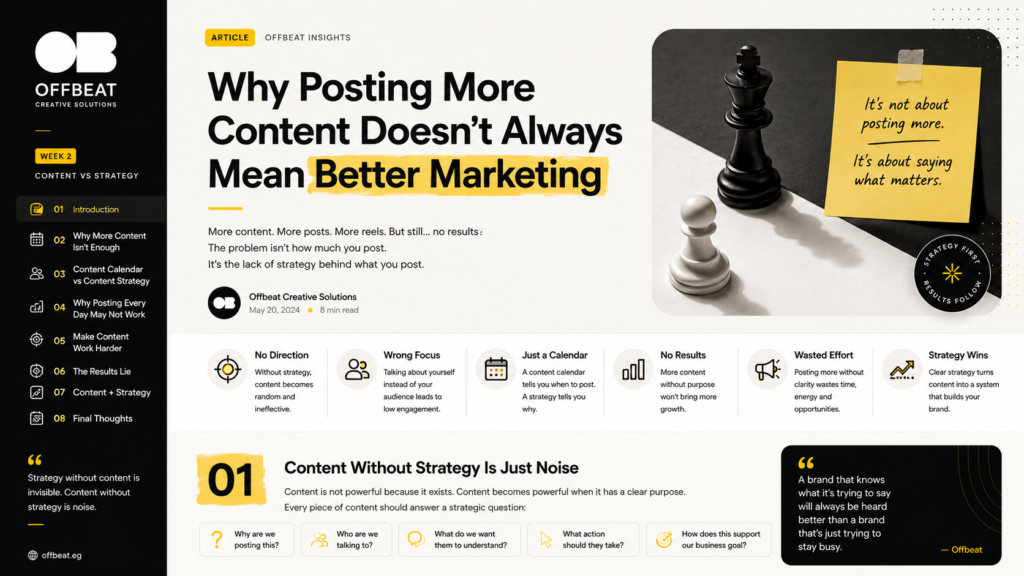
Content Without Strategy Is Just Noise
Content is not powerful because it exists.
Content becomes powerful when it has a clear purpose.
A post should not be created only because the content calendar says something needs to be published today.
A reel should not be produced only because the brand wants to stay active.
A campaign should not be launched only because competitors are doing something similar.
Every piece of content should answer a strategic question:
Why are we posting this?
Who are we talking to?
What do we want them to understand?
What problem are we addressing?
What action should they take next?
How does this support the bigger business goal?
Without these answers, content becomes random.
It may look active, but it does not build direction.
It may fill the page, but it does not build a brand.
A Content Calendar Is Not a Strategy
One of the biggest mistakes brands make is confusing a content calendar with a content strategy.
A content calendar tells you what will be posted and when.
A content strategy tells you why the content exists in the first place.
The calendar is useful.
But the calendar is not the brain.
A calendar can organize posting dates, captions, formats, and platforms.
But it cannot define your brand positioning, your audience needs, your message hierarchy, your customer journey, or your marketing objectives.
For example, posting three times a week is a schedule.
But knowing that one post is designed to build trust, another is designed to explain a service, and another is designed to answer a buying objection — that is strategy.
A strong content strategy connects content to business growth.
A content calendar only organizes the execution.
Why Posting Every Day May Not Work
Posting every day can work for some brands.
But only when there is a clear strategy behind it.
If the content is repetitive, unclear, disconnected from the audience, or focused only on the brand instead of the customer, posting more will not solve the problem.
It may even make the brand feel weaker.
More content can expose weak positioning faster.
More content can make inconsistency more obvious.
More content can confuse the audience if every post says something different.
More content can waste time and budget if it is not connected to performance.
Consistency matters, but consistency alone is not enough.
A brand should not only be consistent in posting.
It should be consistent in message, tone, value, and direction.
The Audience Does Not Care That You Posted
Your audience does not care that your brand posted today.
They care about whether the content matters to them.
Does it solve a problem?
Does it answer a question?
Does it make something clearer?
Does it show value?
Does it build trust?
Does it make the brand easier to understand?
Does it help them make a decision?
This is why audience understanding is one of the most important parts of content marketing.
A brand should not create content only from its own perspective.
It should create content from the audience’s perspective.
Instead of asking:
“What do we want to say today?”
Ask:
“What does our audience need to hear before they trust us?”
That shift changes everything.
Good Content Has a Job
Every content piece should have a job.
Not every post needs to sell.
Not every reel needs to go viral.
Not every story needs to drive direct messages.
But every piece of content should do something useful for the brand.
Some content builds awareness.
Some content explains the offer.
Some content educates the audience.
Some content builds authority.
Some content answers objections.
Some content shows proof.
Some content drives action.
Some content strengthens brand personality.
When content does not have a job, it becomes decoration.
It may look good, but it does not move the brand forward.
The question is not only “Is this content creative?”
The better question is:
“What role does this content play in the customer journey?”
Strategy Makes Creativity Work Harder
Creativity is important.
Strong visuals, clever copy, good storytelling, and engaging ideas can make people stop and pay attention.
But creativity without strategy can become entertainment without impact.
Strategy gives creativity a direction.
It tells the creative team what message needs to be delivered, who needs to hear it, what emotion needs to be created, and what result the brand is trying to achieve.
A creative idea should not only be beautiful.
It should be useful.
It should help the brand become clearer, more memorable, and more relevant to the right audience.
That is when creative direction becomes a business tool, not just an aesthetic choice.
Why Your Brand May Be Posting a Lot but Not Getting Results
If your brand is posting consistently but not seeing results, the issue may be one of these problems:
Your message is not clear enough.
Your audience is not properly defined.
Your content is too focused on the brand, not the customer.
Your posts are not connected to a sales process.
Your content pillars are too generic.
Your creative direction is inconsistent.
Your content does not answer real customer objections.
Your reports measure activity, not impact.
Your content calendar exists, but your strategy does not.
The solution is not always to post more.
Sometimes, the solution is to stop, review, and rebuild the direction.
What Better Marketing Actually Looks Like
Better marketing is not always more content.
Better marketing is clearer content.
Content that knows who it is speaking to.
Content that supports a specific business goal.
Content that makes the brand easier to understand.
Content that builds trust over time.
Content that connects with the audience’s real needs.
Content that works with ads, website, SEO, and sales.
Content that is measured, improved, and refined.
A strong marketing strategy does not kill creativity.
It protects it from becoming random.
It makes every post, campaign, ad, and message work together.
Content and Strategy Should Work Together
This is not about choosing between content and strategy.
You need both.
Without content, strategy stays invisible.
Without strategy, content becomes directionless.
The strongest brands are not the ones that post the most.
They are the ones that know exactly what they are trying to say and why it matters.
That is how content becomes more than activity.
It becomes a system for brand growth.
At Offbeat Creative Solutions, we believe that marketing is not about creating content just to stay active.
It is about building direction.
We help brands connect strategy, content, creative direction, media buying, social media management, website presence, and performance analysis into one clear growth system.
Because posting every day will not save a brand that does not know what it is trying to say.
Final Thoughts
Posting more content can help your brand only when the content has a clear purpose.
But if your brand is posting without direction, more content will not fix the problem.
It will only create more noise.
Before asking, “How often should we post?”
Ask:
What are we trying to communicate?
Who are we speaking to?
Why should they care?
What do they need to believe before they buy?
What role does each content piece play?
How does this content support business growth?
Marketing is not about filling a calendar.
It is about building clarity, trust, and direction.
And when strategy leads the content, every post becomes more meaningful.