Why Your USP Should Come Before Your Visual Identity
A beautiful brand is not always a strong brand.
Many businesses start their branding journey by thinking about the visual side first.
The logo.
The colors.
The typography.
The packaging.
The Instagram grid.
The website look.
The overall aesthetic.
And while all of these elements matter, they should not be the starting point.
Before your brand looks good, it needs to make sense.
Before people admire your design, they need to understand why your brand exists, what makes it different, and why they should choose it.
That is where your USP comes in.
Your USP, or unique selling proposition, is the clear reason why someone should choose your brand instead of another option.
And if your brand does not have a clear USP, even the most beautiful visual identity can feel empty.
A Beautiful Brand Without a USP Is Not Enough
Design can attract attention.
But attention alone does not build trust, loyalty, or sales.
A premium-looking logo may make people stop for a second.
A clean visual identity may make the brand look professional.
A beautiful Instagram feed may create a good first impression.
But after that first impression, the audience will still ask:
What does this brand offer?
Why is it different?
Why should I trust it?
Why should I buy from it?
What makes it better or more relevant than competitors?
If your brand cannot answer these questions clearly, the design will not be enough.
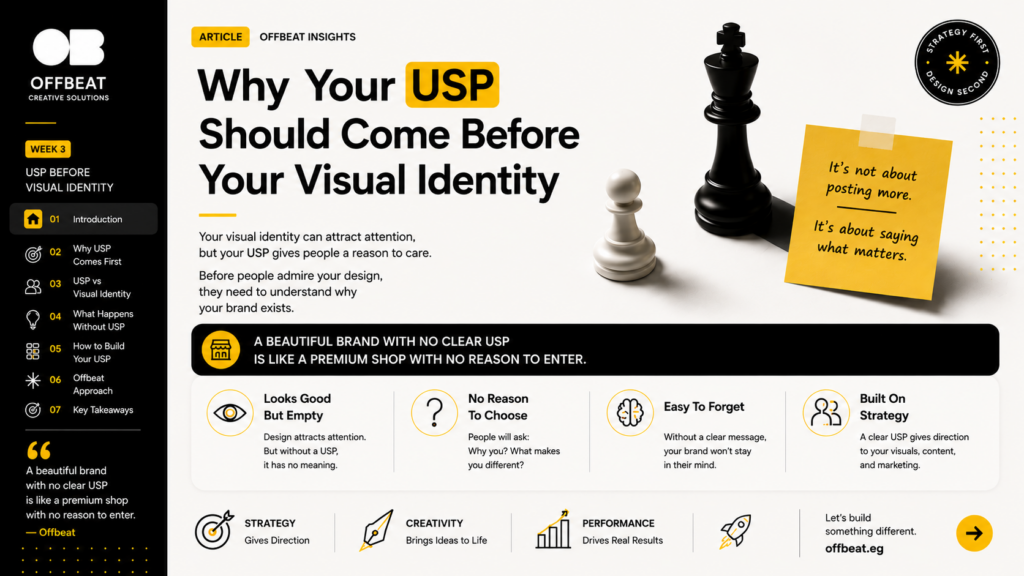
A beautiful brand with no clear USP is like a premium shop with no reason to enter.
It may look attractive from the outside, but people still need a reason to walk in.
Visual Identity Should Translate Strategy, Not Replace It
One of the biggest mistakes in branding is treating visual identity as the strategy itself.
Visual identity is important, but it is not the whole brand.
Your visual identity should translate your strategy into a recognizable look and feel.
It should reflect your positioning, personality, audience, promise, and value.
For example, if your brand wants to feel premium, your visual identity should support that feeling.
If your brand wants to feel friendly and accessible, the design should communicate that.
If your brand wants to be seen as bold, expert-led, luxurious, playful, minimal, local, global, or innovative, the visual direction should be built around that positioning.
But the positioning needs to exist first.
Without strategy, design becomes a guessing game.
You may end up with something that looks good but does not say the right thing.
Your USP Gives Direction to Your Brand
A strong USP helps every part of the brand become clearer.
It helps define your message.
It helps shape your tone of voice.
It helps guide your content.
It helps improve your campaigns.
It helps make your visual identity more meaningful.
It helps your audience understand why your brand matters.
Your USP is not just a sentence you put on a website.
It is the foundation of how your brand communicates.
For example, two brands can sell the same product, but their USP can completely change how they should be marketed.
One brand may focus on premium quality.
Another may focus on affordability.
Another may focus on speed.
Another may focus on local culture.
Another may focus on sustainability.
Another may focus on expertise or personalization.
The product may be similar, but the reason to choose the brand is different.
That reason should shape the entire brand identity.
Branding Should Start With Business Thinking
Strong branding is not only a creative process.
It is a business process.
Before choosing colors, fonts, or visual styles, a brand needs to answer deeper questions:
Who are we targeting?
What problem do we solve?
What makes us different?
What do we want to be known for?
What does the audience care about?
What do competitors already own in the market?
What position can we own?
What promise can we make and actually deliver?
Why should someone choose us?
These questions are not design questions.
They are business and strategy questions.
But they directly affect the design.
Because when the business thinking is clear, the creative direction becomes stronger.
Why Many Brands Look Good but Feel Forgettable
Some brands look visually impressive but still fail to stay in people’s minds.
This usually happens because the brand identity is not connected to a clear strategic idea.
The design may be clean.
The colors may be trendy.
The content may look professional.
The website may feel modern.
But the brand does not own a clear message.
It does not give the audience a strong reason to remember it.
In a crowded market, looking good is not enough.
Many competitors can look good.
But not every competitor can be clearly positioned.
A memorable brand is not just visually attractive.
It is easy to understand, easy to remember, and easy to choose.
Brand Positioning Comes Before Design
Brand positioning is the place your brand owns in the mind of the customer.
It defines how people should perceive you compared to competitors.
Are you the premium choice?
The practical choice?
The fastest choice?
The expert choice?
The creative choice?
The safest choice?
The most accessible choice?
The most personalized choice?
When positioning is clear, visual identity has a job.
The design is no longer just about personal taste.
It becomes a tool to support a specific perception.
This is why brand positioning should come before design.
Because if you do not know what position you want to own, your visual identity may look attractive but still lack direction.
Your Visual Identity Should Help People Feel Your USP
A strong visual identity does more than look nice.
It makes people feel the brand’s promise.
If your USP is about simplicity, the design should feel simple.
If your USP is about expertise, the design should feel credible and structured.
If your USP is about luxury, the design should feel premium and refined.
If your USP is about creativity, the design should feel original and expressive.
If your USP is about speed, the design should feel direct, clear, and efficient.
This is how visual identity becomes strategic.
It turns the brand’s value into something people can see, feel, and remember.
The Right Order: Strategy First, Identity Second
A strong brand usually follows this order:
Understand the business.
Understand the audience.
Study the competitors.
Define the positioning.
Clarify the USP.
Build the brand message.
Create the visual identity.
Apply it across content, website, ads, and campaigns.
This does not mean design is less important.
It means design becomes more powerful when it is built on the right foundation.
When strategy comes first, visual identity becomes more than decoration.
It becomes communication.
Offbeat’s Approach to Branding and Marketing
At Offbeat Creative Solutions, we believe a brand should not start with how it looks.
It should start with what it stands for.
That is why we look at branding and marketing through a business-first lens.
Before working on visuals, content, campaigns, or creative direction, we focus on understanding the brand’s audience, positioning, USP, message, and growth goals.
Because good design can make people notice you.
But clear strategy gives them a reason to remember you.
And the strongest brands are the ones that combine both.
Strategy gives the brand meaning.
Visual identity gives that meaning a recognizable form.
Marketing turns that meaning into consistent communication.
Final Thoughts
Your visual identity is important.
But it should not carry the whole brand alone.
A logo cannot explain your difference if your difference is not clear.
A color palette cannot create trust if your message is weak.
A beautiful feed cannot build growth if your brand has no clear reason to be chosen.
Before building your visual identity, define your USP.
Understand what makes your brand valuable, different, and relevant.
Because when your USP is clear, your design becomes stronger.
Your content becomes sharper.
Your campaigns become more focused.
And your brand becomes easier to understand, remember, and choose.
A beautiful brand can attract attention.
But a clear USP gives people a reason to stay.