What to Fix Before You Increase Your Ad Budget
When ads are not producing the expected results, many businesses ask the same question:
“Should we increase the budget?”
Sometimes the answer is yes.
But many times, the better question is:
“What should we fix before spending more?”
Paid ads can help your brand reach more people, generate traffic, and create opportunities.
But if the journey after the click is weak, increasing the budget may only make the problem bigger.
More ad spend can bring more visitors.
But it cannot automatically create trust.
It cannot fix an unclear offer.
It cannot improve a confusing landing page.
It cannot explain weak positioning.
It cannot repair a slow sales follow-up process.
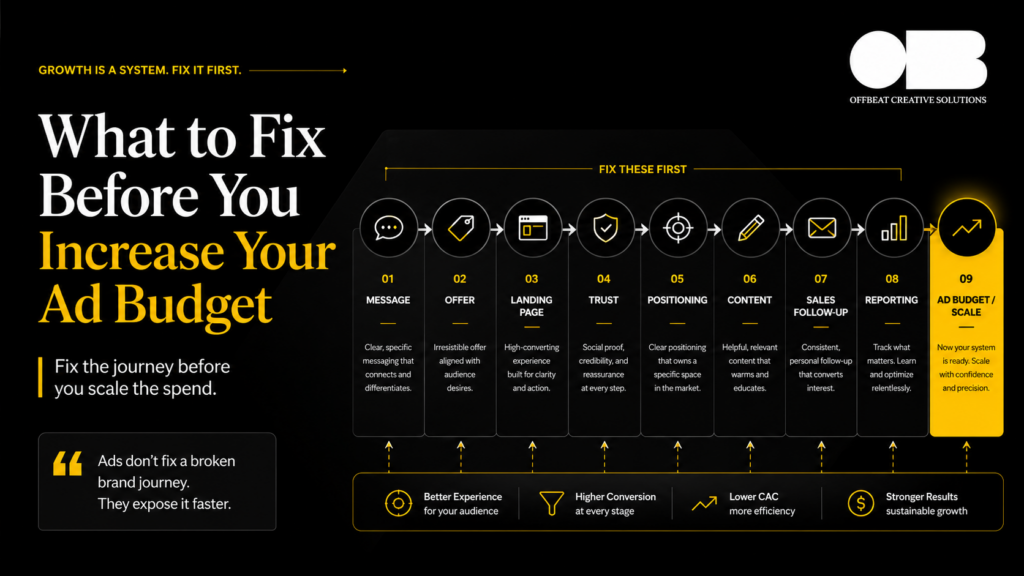
Before increasing your ad budget, your brand needs to make sure the full journey is ready.
Because ads do not fix a broken brand journey.
They expose it faster.
More Budget Does Not Always Mean Better Results
A higher budget can help a strong campaign scale.
But it can also make a weak campaign waste money faster.
If the campaign is already showing signs of poor conversion, increasing spend may not solve the issue.
It may only increase:
More unqualified traffic
More expensive leads
More abandoned landing page visits
More weak inquiries
More pressure on the sales team
More confusion in reporting
A budget increase should happen when the system is ready to handle more attention.
Before scaling, you need to know whether the issue is the ad itself or the journey around it.
Fix the Message First
Your ad message is usually the first thing people see.
If the message is unclear, generic, or disconnected from the audience’s real problem, the campaign may struggle even with strong targeting.
A good ad message should quickly communicate:
Who the offer is for
What problem it solves
Why it matters now
What makes it different
What action the audience should take next
Many ads fail because they sound like every other competitor.
They use broad phrases such as:
“Grow your business.”
“Get the best solution.”
“Take your brand to the next level.”
“Start your journey today.”
These messages may sound positive, but they are often too vague.
If your audience does not immediately understand why your offer is relevant, more budget will not create clarity.
Before increasing ad spend, sharpen the message.
Fix the Offer
Sometimes the ad is doing its job.
It brings attention.
But the offer is not strong enough to move people forward.
An offer does not always mean a discount.
It means the value you are presenting to the audience.
A strong offer should be clear, relevant, believable, and easy to understand.
Ask:
Is the offer specific?
Does it solve a real problem?
Is the value obvious?
Is there a clear reason to act now?
Is the next step easy?
Does the offer match the audience’s awareness level?
For example, a cold audience may not be ready to book a full service immediately.
They may need an audit, consultation, guide, case study, or comparison first.
The offer should match where the audience is in the journey.
If the offer is weak, increasing budget may only bring more people to something they are not ready to accept.
Fix the Landing Page
The landing page is where many campaigns lose performance.
An ad can generate interest, but the landing page needs to turn that interest into action.
A strong landing page should answer the visitor’s main questions quickly:
What is this?
Who is it for?
Why should I trust it?
What makes it different?
What do I get?
What should I do next?
If the landing page is slow, confusing, too long, too short, poorly structured, or visually disconnected from the ad, conversion can drop.
Common landing page problems include:
Unclear headline
Weak call to action
No proof or testimonials
Too much text without structure
No clear explanation of the offer
Poor mobile experience
Slow loading speed
Different message from the ad
No reason to trust the brand
Before increasing your ad budget, make sure your landing page is built to convert.
Traffic is valuable only if the page can handle it.
Fix Trust Signals
People rarely convert only because they saw an ad.
They need trust.
This is especially important for service-based businesses, high-ticket offers, B2B companies, real estate, healthcare, education, legal services, and marketing agencies.
Trust signals may include:
Case studies
Testimonials
Client logos
Before-and-after examples
Portfolio work
Process explanation
Reviews
Team experience
Clear contact information
Professional website design
Helpful content
If the audience does not see enough proof, they may hesitate.
A campaign can generate traffic, but trust is what helps people move closer to action.
Before scaling ads, make sure your brand gives people reasons to believe.
Fix Brand Positioning
Sometimes ads fail because the brand does not have a clear position.
The audience may see the ad, visit the page, and still ask:
Why this brand?
Why not another option?
What makes this different?
Why should I choose them?
Brand positioning helps answer these questions.
It defines how the brand should be understood in the market.
A strong position makes the ad message sharper, the landing page clearer, the content more consistent, and the sales conversation easier.
Without positioning, ads may only create visibility without preference.
And visibility without preference rarely leads to strong growth.
Fix the Content Around the Campaign
Paid ads do not exist in isolation.
People may see your ad, then check your social media page, website, Google Business Profile, LinkedIn, reviews, articles, or previous content before taking action.
This means your content should support the campaign.
If your ad promises strategic thinking, but your social content looks random, the audience may feel a disconnect.
If your ad promotes expertise, but there are no articles, case studies, or proof points, the audience may hesitate.
If your ad pushes a service, but your page does not explain that service clearly, people may not move forward.
Supporting content helps people understand and trust the offer.
Before increasing budget, check whether your content ecosystem supports the campaign message.
Fix the Sales Follow-Up
A paid ads campaign does not end when a lead is generated.
For many businesses, the result depends on what happens after the lead comes in.
Sales follow-up can make or break campaign performance.
Ask:
How fast does the team respond?
Does the team understand the campaign promise?
Are leads being qualified properly?
Are objections being recorded?
Is there a clear follow-up process?
Are lost leads being analyzed?
Is sales feedback shared with marketing?
Sometimes marketing produces leads, but the sales process loses them.
If the follow-up is slow, unclear, or disconnected from the ad message, increasing budget may only create more missed opportunities.
Fix the Reporting
Before scaling your campaign, you need to understand what is actually happening.
Do not look only at surface metrics like clicks, reach, impressions, or cost per lead.
These metrics are useful, but they do not tell the full story.
You also need to measure:
Landing page conversion rate
Qualified lead rate
Cost per qualified lead
Sales conversion rate
Cost per customer
Lead response time
Revenue generated
Customer quality
Common objections
Drop-off points in the journey
A campaign may have cheap clicks but poor sales.
Another campaign may have fewer leads but better customers.
Good reporting helps you know what to fix before spending more.
When Should You Increase the Ad Budget?
Increasing the budget makes sense when the system is already showing healthy signals.
For example:
The message is clear
The offer is converting
The landing page performs well
Lead quality is strong
Sales follow-up is working
The cost per customer is acceptable
The campaign has enough data
The business can handle more volume
Scaling should not be based on hope.
It should be based on evidence.
If the journey is working, more budget can help amplify it.
If the journey is broken, more budget may only expose the cracks.
The Offbeat Approach
At Offbeat Creative Solutions, we do not treat paid ads as a separate activity from the rest of the brand.
We connect media buying with positioning, content, landing pages, offers, reporting, and sales goals.
Before scaling campaigns, we look at the full journey.
Because the problem is not always the audience.
It is not always the budget.
It is not always the platform.
Sometimes the campaign is only revealing what the brand journey needs to fix.
Our goal is to help brands build advertising systems that are ready to convert, not just ready to spend.
Final Thoughts
Before increasing your ad budget, fix the journey.
Make the message clearer.
Strengthen the offer.
Improve the landing page.
Add trust signals.
Clarify the positioning.
Support the campaign with content.
Align sales follow-up.
Measure beyond clicks.
Paid ads can be powerful.
But they work best when the full brand journey is ready.
More budget can scale growth.
But only if the system behind the ad is strong enough to convert attention into results.