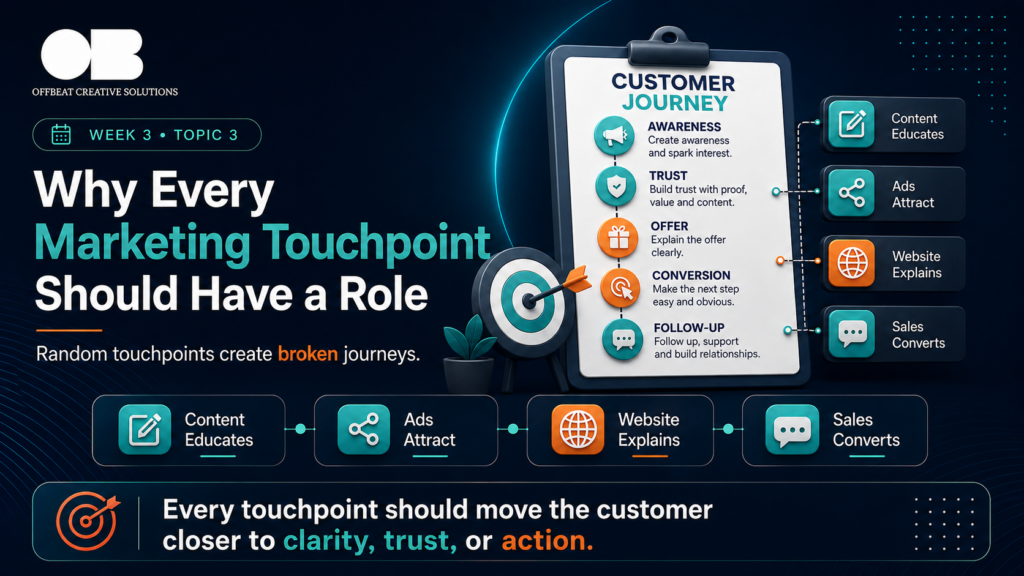
Why Every Marketing Touchpoint Should Have a Role
Your audience does not experience your brand through one post.
They experience it through many touchpoints.
A social media post.
An ad.
A website page.
A Google Business profile.
A LinkedIn article.
A review.
A landing page.
A sales message.
A follow-up call.
Each touchpoint tells the audience something about the brand.
If those touchpoints are disconnected, the journey becomes confusing.
If they work together, the brand becomes easier to understand, trust, and choose.
That is why every marketing touchpoint should have a role.
What Is a Marketing Touchpoint?
A touchpoint is any moment where the audience interacts with your brand.
It could be a piece of content, a campaign, a page, a conversation, or a review.
Examples include:
Instagram posts
Reels
Paid ads
Landing pages
Website pages
Blog articles
Google Business posts
LinkedIn posts
Case studies
Testimonials
Sales calls
DM replies
Email follow-ups
Each one should support the customer journey.
If a touchpoint exists only to fill space, it may not help the business grow.
Random Touchpoints Create Broken Journeys
Many brands create content without assigning roles.
They post because the calendar needs posts.
They run ads because traffic is needed.
They publish articles because SEO matters.
They update the website because it should look active.
But without a clear journey, these touchpoints may not connect.
The audience may see a post but not understand the offer.
They may click an ad but land on a weak page.
They may visit the website but not find proof.
They may send a message but receive a disconnected sales response.
Random touchpoints create broken journeys.
Awareness Touchpoints
Some touchpoints should create awareness.
Their role is to help people notice the brand and understand the problem.
Awareness content may include:
Problem-based posts
Educational reels
Industry insights
Pain point captions
Introductory ads
Short thought leadership posts
The goal is not always direct conversion.
The goal is to make the audience think:
This brand understands something relevant to me.
Trust Touchpoints
Some touchpoints should build trust.
Trust is what helps people move from attention to consideration.
Trust touchpoints may include:
Case studies
Testimonials
Client results
Reviews
Portfolio work
Behind-the-scenes content
Process explanations
Educational articles
Strong trust touchpoints reduce hesitation.
They help the audience feel that the brand can deliver.
Offer Touchpoints
Some touchpoints should explain the offer.
These help people understand what the brand provides and why it matters.
Offer touchpoints may include:
Service pages
Offer posts
Landing pages
Campaign pages
Explainer content
Comparison posts
FAQ sections
The goal is clarity.
The audience should understand what is being offered, who it is for, what problem it solves, and what the next step is.
Objection-Handling Touchpoints
Customers often hesitate before buying.
They may wonder:
Is this right for me?
Is it worth the price?
Will it work?
Why should I trust this brand?
What makes this different?
Objection-handling content helps answer these questions early.
This can appear in posts, articles, FAQs, landing pages, sales scripts, or email follow-ups.
When objections are handled before the sales conversation, the journey becomes smoother.
Conversion Touchpoints
Some touchpoints should guide action.
These include:
Landing page CTAs
Booking forms
Contact buttons
DM prompts
Consultation pages
Offer ads
Retargeting campaigns
Sales follow-ups
Conversion touchpoints should be simple, clear, and connected to the previous stage.
If the audience is ready to act, the brand should not make them search for the next step.
Sales Touchpoints
Sales is part of the marketing journey.
The way a brand responds to leads affects conversion.
A sales message should continue the same promise the campaign started.
If the ad says one thing and the sales conversation says another, the customer may lose trust.
Sales touchpoints should be fast, clear, helpful, and aligned with the brand message.
Marketing creates the path.
Sales helps complete it.
How to Assign Roles to Touchpoints
Before creating content or campaigns, ask:
Is this touchpoint for awareness?
Is it for education?
Is it for trust?
Is it for proof?
Is it for offer clarity?
Is it for objection handling?
Is it for conversion?
Is it for follow-up?
If the team cannot answer, the touchpoint may need more direction.
Every post does not need to sell.
Every ad does not need to explain everything.
Every article does not need to convert immediately.
But every touchpoint should have a purpose.
The Offbeat Approach
At Offbeat Creative Solutions, we build marketing around the customer journey.
We do not treat posts, ads, websites, and sales messages as separate pieces.
We connect them.
Each touchpoint should move the audience closer to clarity, trust, or action.
Because good marketing is not only about being visible.
It is about guiding the customer through a journey that makes sense.
Final Thoughts
A strong marketing system is not built from random activity.
It is built from connected touchpoints.
Some create awareness.
Some build trust.
Some explain the offer.
Some answer objections.
Some drive action.
When every touchpoint has a role, the customer journey becomes smoother.
And when the journey becomes smoother, campaigns become more effective.