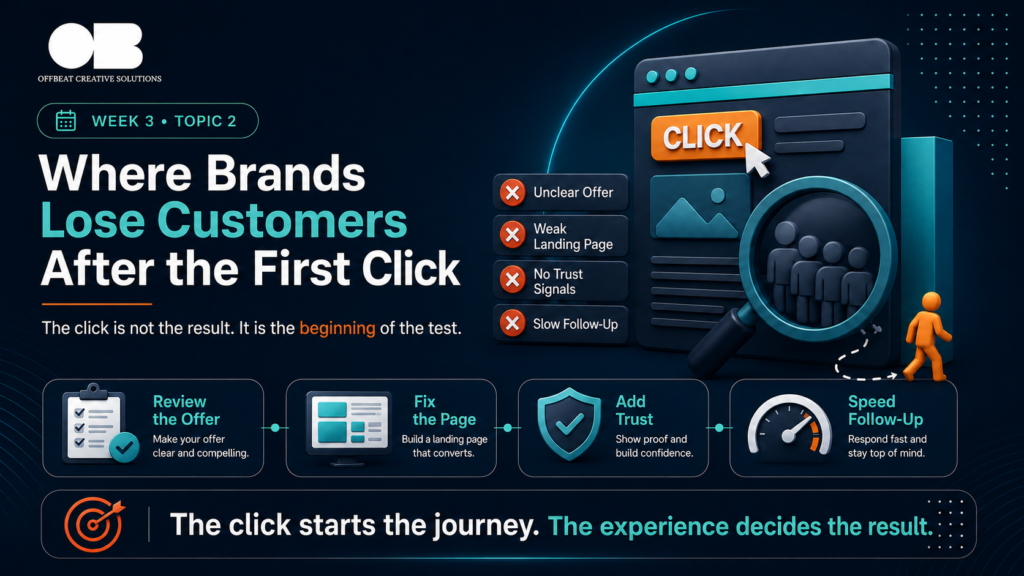
Where Brands Lose Customers After the First Click
Getting clicks can feel like a win.
The campaign is live.
The audience is responding.
Traffic is coming in.
People are showing interest.
But clicks are not the final result.
A click only means someone was interested enough to take the first step.
What happens after that is what decides whether the campaign becomes useful or wasted.
Many brands do not lose customers because the campaign is bad.
They lose them after the first click.
The Click Is the Beginning of the Test
A click is not a conversion.
It is the beginning of the real test.
After someone clicks, the brand has to prove that the message was worth their attention.
The landing page needs to match the campaign.
The offer needs to be clear.
The page needs to build trust.
The next step needs to be obvious.
The experience needs to feel smooth.
If any of these things fail, the customer may leave.
That is why campaign performance should not be judged only by clicks.
Clicks show interest.
The journey after the click shows whether the brand can convert that interest.
Problem 1: Message Mismatch
One of the most common reasons brands lose customers after the click is message mismatch.
This happens when the ad says one thing, but the landing page says something else.
The campaign may promise a specific solution, but the page talks generally about the company.
The ad may focus on one problem, but the website opens with a broad headline.
The creative may feel premium, but the landing page feels basic.
This creates confusion.
When people click, they expect the next step to continue the same conversation.
If the message changes, trust drops.
Problem 2: Unclear Offer
Sometimes people click because the campaign looks interesting, but then they do not understand what is actually being offered.
The offer may be too broad.
The value may not be clear.
The page may describe services without explaining outcomes.
The CTA may feel too early.
The audience may not understand why they should act now.
A clear offer should answer:
What is this?
Who is it for?
What problem does it solve?
What outcome does it support?
Why should I choose this brand?
What should I do next?
If these answers are missing, people may leave even if they were interested.
Problem 3: Weak Trust Signals
People rarely convert only because they clicked an ad.
They need trust.
They may want to see reviews, testimonials, case studies, portfolio work, previous results, team experience, or a clear explanation of the process.
If the page has no proof, the customer may hesitate.
This is especially important for services, high-ticket offers, B2B companies, real estate, education, healthcare, and agencies.
A campaign can create interest.
But trust signals reduce risk.
Without trust, the customer may compare, delay, or leave.
Problem 4: Poor Landing Page Structure
A landing page should guide people.
But many landing pages make people work too hard.
Common issues include:
Unclear headline
Too much text without structure
Weak call to action
No proof
Slow loading
Poor mobile experience
Confusing layout
No clear explanation of the offer
Too many distractions
The page should quickly help visitors understand the value and take the next step.
If the page is confusing, traffic will not matter much.
Problem 5: No Clear Next Step
A customer may be interested but still not act if the next step is unclear.
Should they call?
Send a message?
Book a consultation?
Fill a form?
Download something?
Visit another page?
If the CTA is hidden, vague, or not relevant to the stage of the customer, conversion drops.
The next step should feel simple and natural.
Do not make the customer guess what to do.
Problem 6: Slow Follow-Up
For lead generation campaigns, the journey does not end when someone fills a form or sends a message.
Sales follow-up matters.
If the team responds late, the lead may lose interest.
If the response feels generic, the lead may not feel understood.
If the sales team does not know the campaign promise, the conversation may feel disconnected.
A campaign can generate the opportunity.
But follow-up converts it.
How to Fix the Journey After the Click
To improve post-click performance, brands should review the full experience.
Ask:
Does the landing page match the campaign message?
Is the offer clear?
Is the page mobile-friendly?
Is the CTA obvious?
Is there enough proof?
Does the content answer objections?
Is the sales team ready?
Are leads being followed up quickly?
Are we tracking qualified leads, not just clicks?
This helps identify where the journey is breaking.
The Offbeat Approach
At Offbeat Creative Solutions, we do not stop at campaign setup.
We look at the full path after the click.
We connect campaign messaging with landing pages, offers, content, trust signals, and sales follow-up.
Because the campaign is only the beginning.
The real result happens after the audience takes the first step.
Final Thoughts
Clicks are useful.
But they are not enough.
A campaign that gets clicks but no conversions is usually exposing a journey problem.
Maybe the landing page is weak.
Maybe the offer is unclear.
Maybe trust is missing.
Maybe the CTA is confusing.
Maybe follow-up is slow.
Before increasing the budget or changing the creative, check what happens after the click.
Because the click is not the result.
It is the beginning of the test.