Why Customer Journey Mapping Should Come Before Campaigns
Many brands start campaigns too quickly.
They prepare the creative.
They write the caption.
They set the budget.
They choose the audience.
They launch the ad.
Then they wait for results.
But one important question is often missing:
What happens after people see the campaign?
A campaign is not only about attention.
It is not only about clicks, reach, impressions, or views.
A campaign should move people through a journey.
If that journey is unclear, the campaign may create activity without creating real business results.
That is why customer journey mapping should come before campaigns.
Campaigns Do Not Work in Isolation
A campaign is only one part of the marketing system.
The customer may see an ad, visit a landing page, check the Instagram page, read reviews, compare competitors, send a message, ask a question, wait for a response, and then decide whether to buy.
Every step affects the result.
If one step is weak, the campaign can lose performance.
A strong creative may get attention.
But if the landing page is unclear, people leave.
A good ad may get clicks.
But if the offer is confusing, people hesitate.
A strong post may create interest.
But if there is no proof, people do not trust.
The campaign starts the journey.
But the journey decides the result.
What Is Customer Journey Mapping?
Customer journey mapping means understanding the steps a person goes through before taking action.
It helps the brand answer questions like:
Where does the customer first discover us?
What do they need to understand first?
What objections might stop them?
What proof do they need?
What should happen after they click?
What should they see before they contact us?
What happens after they become a lead?
Where do people usually drop off?
This makes marketing more strategic.
Instead of launching random campaigns, the brand builds a clear path from awareness to trust to conversion.
The Journey Starts Before the Click
Many businesses think the journey starts when someone visits the website or sends a message.
But it starts earlier.
The journey may start with a post, reel, ad, article, Google Business post, LinkedIn post, referral, review, or search result.
That first touchpoint creates an impression.
It tells the audience something about the brand.
If the message is clear, people move forward.
If the message is vague, they may scroll away.
Before launching a campaign, the brand should ask:
What is the first thing we want the audience to understand?
That question shapes the campaign.
The Middle of the Journey Builds Trust
Attention is not enough.
After people notice the brand, they need reasons to trust it.
This is where many campaigns fail.
They bring people in, but they do not give them enough proof.
The middle of the customer journey should support trust through:
Educational content
Case studies
Reviews
Testimonials
Portfolio work
Clear service pages
Useful articles
Objection-handling content
Strong brand positioning
Consistent messaging
If these trust signals are missing, the audience may like the campaign but still not take action.
A campaign can create awareness.
But the journey must build confidence.
The End of the Journey Must Make Action Easy
The final step should be simple.
If the audience is interested, they should know exactly what to do next.
That could be:
Book a call
Send a message
Fill a form
Visit a landing page
Request a proposal
Download a guide
Ask for consultation
Make a purchase
If the next step is unclear, conversion drops.
A strong journey removes confusion.
It guides people naturally from interest to action.
Before launching campaigns, the brand should make sure the call to action is visible, relevant, and easy to follow.
Common Journey Gaps
A customer journey may break for many reasons.
The ad message does not match the landing page.
The landing page does not explain the offer.
The website has no clear CTA.
The content does not build trust.
The social media page looks disconnected from the campaign.
The sales team responds too late.
The audience sees the campaign but does not understand the value.
The brand asks for conversion before building enough trust.
These gaps waste marketing effort.
The issue may not be the campaign itself.
It may be the journey around it.
Why Journey Mapping Improves Campaigns
When the journey is mapped clearly, campaigns become stronger.
The brand knows what the audience needs at every stage.
Awareness campaigns introduce the problem.
Educational content explains the solution.
Proof content builds trust.
Landing pages clarify the offer.
Sales follow-up handles objections.
Retargeting reminds and reassures.
Each part has a role.
This makes the campaign more connected and easier to optimize.
The Offbeat Approach
At Offbeat Creative Solutions, we do not look at campaigns as isolated deliverables.
We look at the full journey around them.
Before launching a campaign, we ask:
What should the audience understand first?
What should they see after the campaign?
Where will the click go?
What proof supports the message?
Is the offer clear?
Is the landing page ready?
Is the sales process prepared?
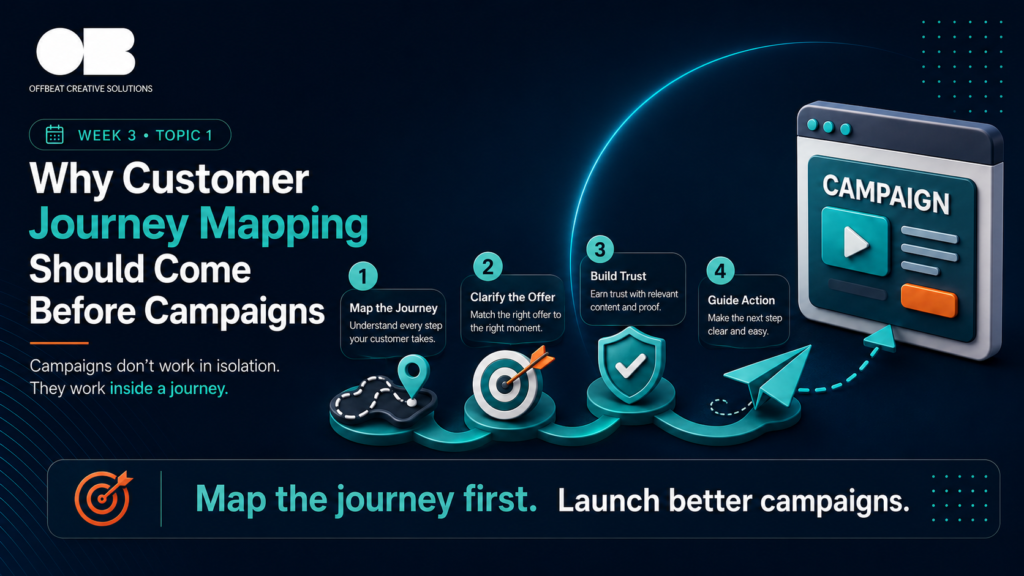
Because campaigns do not work alone.
They work inside a journey.
Final Thoughts
A campaign can bring attention.
But attention does not automatically create growth.
The customer journey decides what happens next.
If the journey is clear, people understand the brand, trust the offer, and know how to take action.
If the journey is broken, the campaign may get views, clicks, and traffic without meaningful results.
Before launching your next campaign, map the journey first.
Because stronger campaigns start with clearer paths.