Why Generic Offers Lead to Generic Marketing
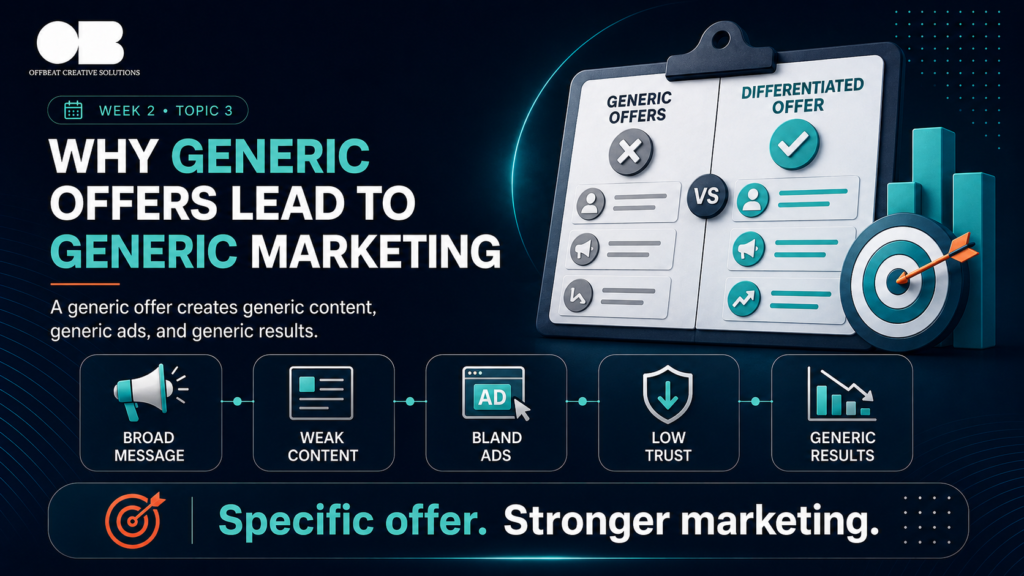
Generic marketing often starts with a generic offer.
A brand may want stronger content, better ads, more engagement, or higher conversion.
But if the offer itself is broad, unclear, or similar to every competitor, the marketing will struggle to feel specific.
The content becomes general.
The ads become predictable.
The website becomes vague.
The sales conversation becomes harder.
The audience sees the brand, but does not clearly understand why it should be chosen.
This is why offer clarity and positioning should come before execution.
A generic offer creates generic marketing.
What Is a Generic Offer?
A generic offer is an offer that does not clearly explain why the brand is different or why the audience should care.
It may sound like:
“We help businesses grow.”
“We provide high-quality marketing services.”
“We create creative solutions.”
“We manage your online presence.”
“We deliver the best results.”
The issue is not that these lines are always wrong.
The issue is that they are not specific enough.
A competitor could say the same thing.
If another business can copy your offer without changing much, the offer is probably too generic.
Generic Offers Make Content Harder
Content needs direction.
It needs a clear message to repeat, explain, prove, and develop.
When the offer is generic, the content team has to create ideas around weak foundations.
This leads to posts that sound nice but do not build a strong brand memory.
The content may become:
Motivational but not strategic
Educational but not connected to the offer
Visual but not meaningful
Consistent but not persuasive
Active but not effective
The page may look alive, but the audience may still not understand what makes the brand worth choosing.
Generic Offers Make Ads More Expensive
Paid ads need fast clarity.
The audience scrolls quickly.
The message has only a few seconds to create interest.
If the offer is generic, the ad has no strong angle.
It may depend too much on visuals, discounts, or broad promises.
This can attract weak clicks or unqualified leads.
A strong ad needs a specific reason for the audience to care.
That reason usually comes from a clear offer.
Without it, the campaign has to work harder to create attention and trust.
Generic Offers Make Websites Confusing
A website should help visitors understand the brand quickly.
But if the offer is generic, the website often becomes a list of services without a clear value story.
Visitors may see:
About us
Services
Portfolio
Contact us
But they may still ask:
Why this brand?
What problem do they solve?
Who do they help best?
What outcome do they support?
What makes them different?
A website built around a generic offer may look professional but still fail to convert.
Design improves presentation.
Offer clarity improves understanding.
Generic Offers Make Sales Conversations Harder
When the offer is unclear, the sales team has to explain too much from the beginning.
Leads may ask basic questions.
They may compare only by price.
They may not understand the value.
They may not see the difference between this brand and another option.
A clear offer prepares the lead before the sales conversation.
A generic offer leaves too much work for the sales team.
That is why sales and marketing both benefit from sharper positioning.
Why Brands Use Generic Offers
Brands often use generic offers because they want to appeal to everyone.
They do not want to become too specific.
They fear that if they define the offer clearly, they may lose potential customers.
But clarity does not weaken the brand.
It strengthens it.
A clear offer helps the right audience recognize the value faster.
Trying to speak to everyone often creates a message that connects with no one deeply.
How to Make an Offer Less Generic
To make an offer stronger, ask:
Who exactly is this for?
What problem are we solving?
What outcome do we help create?
What makes our approach different?
What proof supports the offer?
What pain point do we remove?
What does the customer understand after seeing the message?
What should make them choose us?
Then remove any phrase that competitors can easily copy.
Replace broad claims with specific value.
Instead of saying:
“We help brands grow.”
Say:
“We help service-based brands turn unclear marketing activity into a structured system built around offer clarity, content direction, and conversion-focused execution.”
That sentence is more specific.
It gives the audience something to understand.
Positioning Makes the Offer Stronger
Positioning helps the brand decide what it wants to be known for.
Without positioning, the offer usually becomes too wide.
A brand needs to know:
What market does it serve?
What problem does it solve best?
What type of customer is it best for?
What belief does it want to own?
What makes its approach different?
When positioning is clear, the offer becomes easier to communicate.
Content becomes more focused.
Ads become sharper.
Sales becomes smoother.
The Offbeat Approach
At Offbeat Creative Solutions, we believe generic marketing usually has a strategic reason behind it.
Before creating more content or running more ads, we look at the offer and positioning.
We ask whether the brand is saying something specific enough to be understood, remembered, and chosen.
Because marketing cannot communicate what the business has not clarified.
A clear offer gives every channel a stronger role.
It helps the brand stop sounding like everyone else.
Final Thoughts
Generic offers create generic marketing.
If the offer is broad, the content will be broad.
If the message is vague, the ads will be vague.
If the positioning is unclear, the website will be unclear.
Before asking for more marketing activity, brands should ask whether the offer is strong enough.
Because marketing works better when people understand exactly what is being offered, who it is for, and why it matters.
Clarity is not a small detail.
It is the foundation of stronger marketing.