How to Build a Social Media Strategy That Actually Supports Sales
For many brands in Cairo, social media has become a publishing routine instead of a commercial system. A post goes out, a reel follows, a trend is copied, a campaign is boosted, and the page stays active. But activity is not strategy. If the content does not help people understand the offer, trust the brand, compare options, ask a better question, or take action, the page may look busy while sales stay weak.
At Offbeat, we believe a strong social media strategy should give every post a business role. Some posts attract the right people. Some explain the problem. Some prove credibility. Some answer objections. Some push action. The goal is to make content support the journey from first impression to purchase.
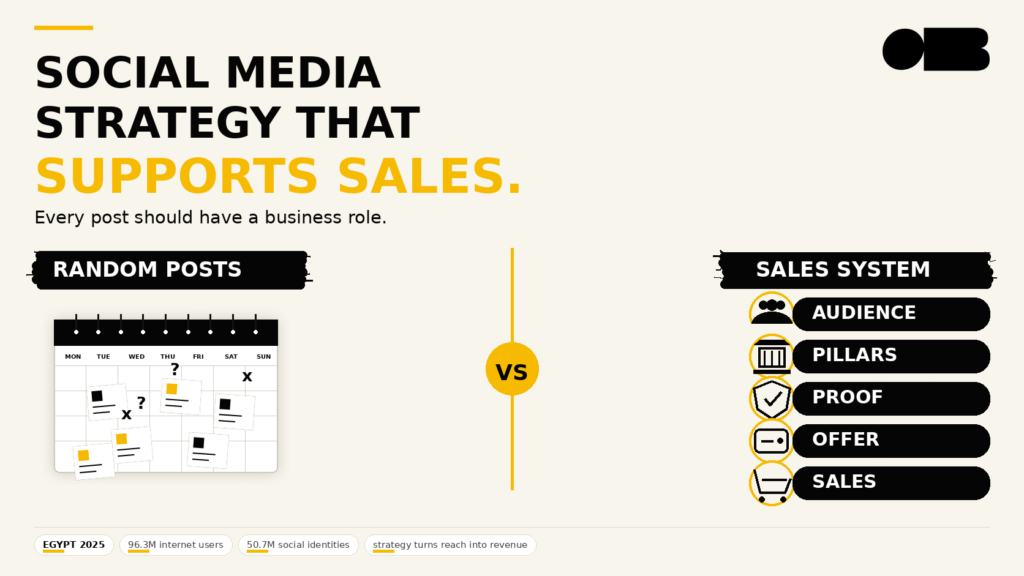
Egypt is not short on digital attention. DataReportal reported 96.3 million internet users in Egypt at the start of 2025, with internet penetration at 81.9%. It also reported 50.7 million social media user identities, equal to 43.1% of the population. Facebook’s ad reach was estimated at 48.7 million users, while Instagram reached 20.1 million users. TikTok’s ad reach was equal to 56.1% of adults aged 18 and above. These numbers explain why brands rush to social platforms, but they also reveal the real challenge: when everyone is present, presence alone is not enough. The strategic question is how to turn reach into revenue.
Start with the sale, not the calendar
A content calendar is useful, but it is not a strategy by itself. A calendar says what will be published. A strategy explains why it should be published, who it is for, what belief it should change, and what commercial action it should support.
Before choosing post ideas, define the sales problem. Is the brand struggling with low awareness? Weak trust? High price objections? Too many low-quality leads? Poor repeat purchase? Each problem needs a different content system.
A clinic that receives many messages but few bookings does not simply need more awareness posts. It needs content that explains the consultation process, reduces fear, shows expertise, and makes booking easier. An e-commerce brand with engagement but low orders may need clearer product proof, size guidance, delivery information, return policy content, and retargeting.
The first question should always be: what is stopping people from buying?
## Build around real audience segments
Many brands describe their audience as “men and women, 18 to 45, Cairo and Giza.” That may help with media buying, but it is too broad for strategy. A sales-focused audience map should identify who is ready to buy now, who is comparing, who needs education, and who influences the decision.
This matters in Egypt because the buying journey often moves across channels. A customer may discover a product on Instagram, ask on WhatsApp, compare prices on Facebook, check comments, then pay through cash on delivery, wallet, InstaPay, or checkout. The National Telecom Regulatory Authority reported that mobile wallets in Egypt exceeded 50 million by the end of 2024, up 25% from 40 million at the end of 2023. More people can act digitally after being convinced digitally, but the content still has to create clarity and trust.
The Central Bank of Egypt also reported that financial inclusion reached 71.5% by June 2024, with 48.1 million eligible citizens holding transactional accounts. For marketers, this means social media should no longer stop at awareness. It should connect attention to a simple next step.
Define content pillars by sales role
Manyrecognizese pillars like “educational, entertaining, promotional.” That is a start, but it is not enough. A stronger system defines content by the role it plays in the funnel.
Problem awareness content helps the audience recognize the pain, risk, desire, or opportunity. For a legal service, that might be why registering a trademark early prevents future disputes. For a café, it could be where to work quietly in Maadi without feeling rushed.
Solution education explains how the product or service works and why it is relevant. Proof content makes the brand believable through reviews, case studies, process videos, expert explanations, user-generated content, and delivery proof. Offer content makes the next step obvious: book, order, request a quotation, visit the branch, download the menu, or ask on WhatsApp. Retention content helps customers come back.
When these pillars work together, the page stops being a collection of random posts and becomes a sales-support system.
Learn from Egyptian market examples
One clear Egyptian example of social content supporting action is Vodafone Egypt’s campaign with Mersal Foundation. According to Vodafone’s own case study, the idea began when a young girl donated an EGP 10 top-up card to Mersal. After the story spread on social media, Vodafone amplified it and matched eligible donations. The campaign raised EGP 11.8 million in a few hours, with EGP 7 million eligible for match funding. The lesson is not only that emotional content works. The deeper lesson is that content works when the action is simple, the proof is visible, and the brand removes friction from participation.
Another useful case is Talabat Egypt and AppGallery during Talabat’s transition from Otlob. The campaign used social media, push notifications, banners, outdoor media, incentives, and influencer activity to drive downloads and activation. Reported results included a 225% increase in total downloads and a voucher redemption rate reaching 40% of total redemptions. The lesson: awareness was not the final goal. The campaign connected brand transition, incentive, platform availability, and activation into one journey.
Performance examples matter too. In an Egypt-focused e-commerce case study, pShift reported reducing cost per purchase from EGP 428.98 to EGP 219.81, improving ROAS from 1.4 to 3.0, and increasing orders from 1,643 to 4,195 after rebuilding the Meta advertising structure. This shows that content and ads should be treated as one performance system, not two separate teams.
Create content for objections
One of the fastest ways to make social media support sales is to list the reasons customers hesitate and create content for each one. Common objections in Egypt include price, delivery time, trust, product quality, payment safety, service credibility, after-sales support, location, availability, and whether the product is worth it.
If customers say the product is expensive, do not only post discounts. Explain materials, durability, comparison, usage frequency, warranty, or total value. If customers ask whether it is original, show sourcing, packaging, reviews, and guarantees. If customers repeatedly ask about delivery, turn delivery information into highlights, pinned posts, and automated replies.
Good content does not avoid objections. It answers them before the customer leaves.
Measure what moves revenue
Likes and reach are not useless, but they are incomplete. A sales-supporting dashboard should separate attention metrics from business metrics: reach, saves, shares, profile visits, link clicks, message starts, cost per lead, lead quality, cost per purchase, conversion rate, average order value, ROAS, repeat purchase, and response time.
For service businesses, track how many inquiries become meetings, proposals, and closed deals. For local businesses, track branch visits, calls, reservations, and location-specific inquiries where possible. The real question is not “which post got the most engagement?” It is “which content helped the right customer move closer to buying?”
The Offbeat framework
At Offbeat Creative Solutions in Cairo, we build social media strategies around five layers: audience, pillars, proof, offer, and measurement. Audience defines who we influence. Pillars define content roles. Proof builds belief. The offer makes action easy. Measurement shows whether the system supports sales.
The brands that win are not always the ones that post the most. They are the ones that understand what each post is supposed to do. In a market as active and competitive as Egypt, strategy is the difference between being seen and being chosen.