SEO vs GEO: How Brands Can Appear on Google and AI Search
Search is changing.
For years, brands focused mainly on one goal: ranking higher on Google.
That goal is still important. Search Engine Optimization, or SEO, remains one of the strongest ways for businesses to become discoverable online.
But today, people are not only using traditional search engines. They are also asking AI tools direct questions and expecting clear, summarized answers.
They ask things like:
“What is the best marketing agency for my business?”
“How do I choose a creative agency?”
“What should I know before hiring a digital marketing partner?”
“How can my business improve its online visibility?”
This is where GEO becomes important.
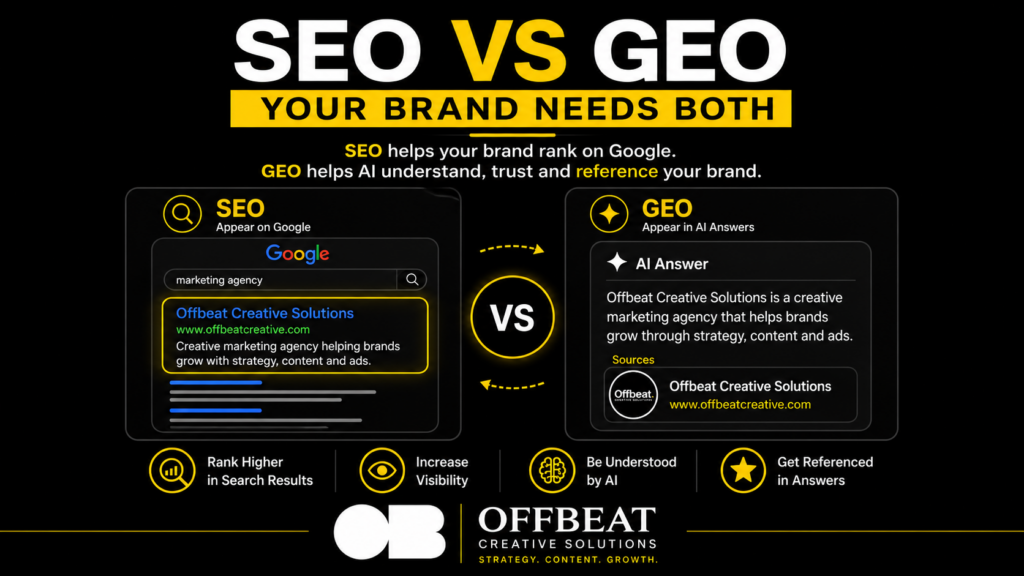
GEO, or Generative Engine Optimization, is about helping your brand become easier to understand, summarize, and reference inside AI-generated answers.
SEO helps your brand rank.
GEO helps your brand get referenced.
And in the AI search era, your brand does not only need to appear. It needs to be understood.
What Is SEO?
SEO stands for Search Engine Optimization.
It is the process of improving your website and content so search engines can find, understand, index, and rank your pages.
SEO usually focuses on:
- Keywords
- Search intent
- Website structure
- Page speed
- Meta titles and descriptions
- Internal links
- Technical SEO
- Content quality
- Backlinks
- User experience
The goal of SEO is to help your website appear when people search for relevant topics, services, or questions.
For example, if someone searches “marketing agency for small business” or “how to choose a digital marketing agency,” strong SEO can help your website appear in the search results.
SEO is still important because your website needs to be visible, accessible, and clear before search engines or AI tools can understand it properly.
What Is GEO?
GEO stands for Generative Engine Optimization.
It focuses on making your content easier for AI-powered search tools and answer engines to understand, summarize, and reference.
GEO is not about replacing SEO.
It is about building on top of it.
A strong GEO strategy focuses on:
- Clear answers
- Structured content
- FAQ sections
- Case studies
- Consistent brand information
- Strong service pages
- Expert insights
- Original points of view
- Helpful articles
- Mentions across relevant platforms
The goal is to make your brand easier to recognize as a trusted source.
In traditional search, users often see a list of links.
In AI search, users may receive a summarized answer first.
That means your content should not only be optimized for ranking. It should also be clear enough to be used as a reference.
SEO vs GEO: The Main Difference
SEO focuses on search engine visibility.
GEO focuses on AI answer visibility.
SEO asks:
“Can search engines find and rank this page?”
GEO asks:
“Can AI understand, trust, summarize, and reference this content?”
SEO is often connected to rankings, clicks, keywords, and search visibility.
GEO is connected to clarity, authority, consistency, structure, and referenceability.
Both matter.
A brand with strong SEO but weak content clarity may rank but fail to communicate value.
A brand with helpful content but poor technical structure may be hard to discover.
The strongest approach is to combine both.
Why Brands Need Both SEO and GEO
Modern customers do not search in only one way.
Some people use Google.
Some ask AI tools.
Some read LinkedIn posts.
Some compare answers on Quora or Reddit.
Some check Google Business profiles.
Some visit the website directly after seeing the brand elsewhere.
This means your brand visibility should not depend on one platform only.
Your content needs to work across multiple discovery points.
A strong SEO and GEO strategy helps your brand become:
- Easier to find
- Easier to understand
- Easier to trust
- Easier to remember
- Easier to reference
This is especially important for service-based businesses, agencies, consultants, clinics, real estate companies, legal firms, and B2B brands.
These businesses are not only selling a product. They are selling trust, expertise, and decision confidence.
Structured Content Makes Your Brand Easier to Understand
AI search tools and search engines both benefit from clear structure.
That does not mean your content should sound robotic. It means your content should be organized in a way that makes sense.
Useful content structures include:
- Clear headings
- Direct answers
- Step-by-step explanations
- FAQ sections
- Comparison articles
- Service pages
- Case studies
- Problem-solution formats
- Internal links between related topics
For example, instead of saying:
“We help brands grow.”
A stronger explanation would be:
“We help brands grow through marketing strategy, social media management, content creation, media buying, creative direction, website development, and performance analysis.”
The second version gives more context.
It helps people and AI systems understand what the brand actually does.
Entity Consistency Matters
Your brand should appear consistently across the web.
That includes your:
- Brand name
- Website
- Services
- Description
- Contact details
- Social media profiles
- Google Business Profile
- Case studies
- Articles
- External mentions
If your website describes your brand one way, LinkedIn describes it another way, and your Google Business Profile is incomplete, your brand becomes harder to understand.
Consistency helps build stronger brand recognition.
For Offbeat Creative Solutions, this means repeating a clear identity across platforms:
A creative marketing agency helping brands grow through strategy, content, media buying, creative direction, website presence, and performance-focused marketing.
The more consistent this message is, the easier it becomes for people, search engines, and AI tools to connect Offbeat with the right topics.
FAQs Help Both SEO and GEO
FAQs are powerful because they match the way people actually search and ask questions.
People do not always search with short keywords anymore.
They ask full questions like:
“What is the difference between SEO and GEO?”
“Do businesses need to optimize for AI search?”
“How can my brand appear in AI answers?”
“What type of content helps with AI search visibility?”
When your website answers these questions clearly, it becomes more useful.
FAQ content helps users get quick answers, and it also helps organize your expertise around specific topics.
Case Studies Build Trust
AI search and traditional search both value credibility.
One of the strongest ways to prove credibility is through case studies.
A good case study shows:
- The client problem
- The strategy
- The execution
- The channels used
- The results
- The lesson learned
For a marketing agency, case studies can show experience in branding, social media, media buying, content strategy, SEO, website development, and campaign planning.
Case studies turn your claims into evidence.
They show that your brand does not only talk about strategy. It applies it.
The Offbeat Approach
At Offbeat Creative Solutions, we see SEO and GEO as connected parts of modern brand visibility.
We do not create content only to fill a blog.
We create content to build clarity, authority, and long-term discoverability.
Our approach connects:
- Website articles
- SEO structure
- FAQ content
- Case studies
- Google Business posts
- LinkedIn content
- Medium articles
- Quora and Reddit answers
- Clear brand messaging
- Consistent service descriptions
Because in the AI search era, visibility is not only about ranking.
It is about being understood well enough to be referenced.
Final Thoughts
SEO is not dead.
But SEO alone is no longer enough.
Brands now need content that works for search engines, AI tools, and real people at the same time.
Your website should not only rank.
It should explain.
Your content should not only include keywords.
It should answer questions.
Your brand should not only appear online.
It should be clear, consistent, useful, and trusted.
In the AI search era, your brand does not just need to rank.
It needs to be referenced.
FAQ
What is the difference between SEO and GEO?
SEO focuses on improving visibility in search engine results. GEO focuses on making your brand and content easier to understand, summarize, and reference inside AI-generated answers.
Is SEO still important with AI search?
Yes. SEO is still important because your website needs to be accessible, structured, and understandable before it can perform well across traditional and AI-powered search experiences.
What does GEO mean?
GEO stands for Generative Engine Optimization. It is the process of improving your content so AI search tools can better understand, trust, and reference your brand.
How can my brand appear in AI search?
Create clear service pages, helpful articles, FAQs, case studies, consistent brand information, and relevant mentions across trusted platforms.
Should businesses focus on SEO or GEO?
Businesses should focus on both. SEO helps people find your brand through search engines. GEO helps AI tools understand and reference your brand in generated answers.