1. A Cheap Result Can Still Be Expensive
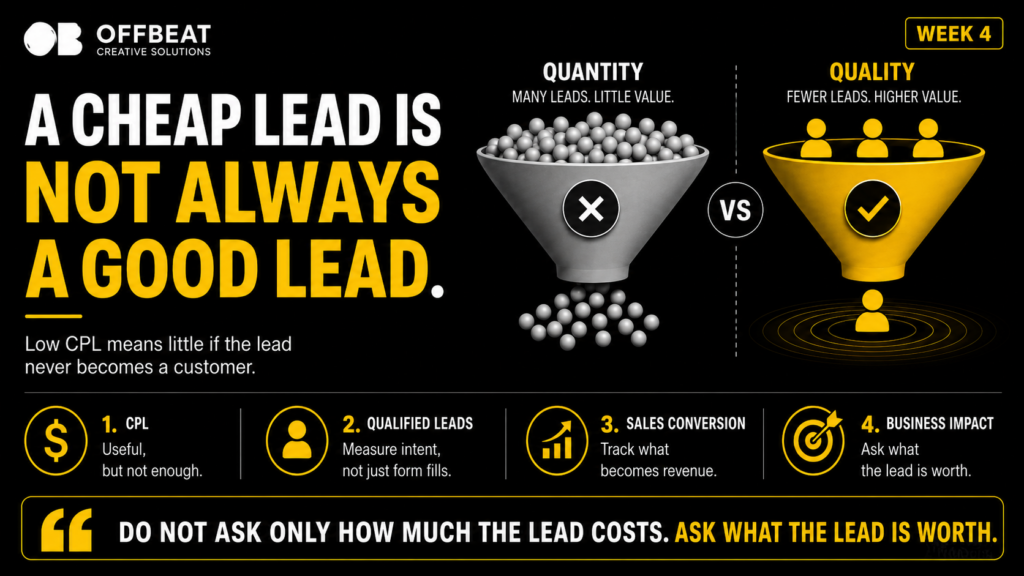
A campaign may generate a low cost per lead and still fail the business.
Why?
Because not every lead has the same value.
Some people may submit a form without understanding the service.
Some may not fit the target customer profile.
Some may never answer the sales team.
Others may be interested but unable to buy.
The number looks good inside the advertising dashboard, but the business sees no real return.
2. Platform Metrics Tell Only Part of the Story
Metrics such as CPC, CPM, CTR, reach, and impressions help diagnose campaign activity.
But they do not automatically prove business success.
A high click-through rate tells you that the ad attracted clicks.
It does not tell you whether those clicks became qualified leads, customers, or revenue.
A low cost per lead tells you that the campaign generated form submissions efficiently.
It does not tell you whether the sales team could close them.
3. Connect Advertising Data With Sales Data
Media buying should not stop at the advertising platform.
The marketing team needs feedback from sales.
Ask:
- How many leads answered?
- How many were qualified?
- How many requested a proposal?
- How many completed a purchase?
- What objections appeared repeatedly?
- Which campaign produced the strongest customers?
- What was the final cost per customer?
Without this connection, campaign optimization may focus on cheaper leads rather than better customers.
4. Lead Quality Starts Before the Form
Poor lead quality is not always a targeting problem.
It can be caused by unclear advertising.
If the ad exaggerates the offer, hides important information, or attracts people using a broad promise, it may produce many low-intent inquiries.
A clear message may generate fewer leads, but those leads can be more relevant.
Good advertising does not only persuade people to click.
It helps the wrong customers understand that the offer is not for them.
5. Measure Based on the Business Objective
The right metric depends on what the campaign needs to achieve.
For awareness campaigns, relevant metrics may include reach, frequency, video completion, and brand lift indicators.
For lead-generation campaigns, the business should study lead quality, qualified lead rate, cost per qualified lead, and sales conversion.
For e-commerce campaigns, revenue, conversion rate, average order value, customer acquisition cost, and return on ad spend may be more useful.
There is no single metric that explains every campaign.
6. Better Reporting Leads to Better Decisions
A useful media buying report should not only display numbers.
It should answer:
- What happened?
- Why did it happen?
- What did we learn?
- What should we test next?
- How did advertising affect the business?
Reporting should turn data into decisions.
7. The Offbeat Approach
At Offbeat Creative Solutions, we evaluate campaign performance beyond surface-level numbers.
We connect creative performance, platform data, lead quality, customer behavior, and business outcomes.
Because the goal is not simply to produce the cheapest click or the largest number of leads.
The goal is to create marketing activity that supports real business growth.
Conclusion line:
Do not ask only how much the lead costs.
Ask what the lead is worth.