Is AI Content Enough for Brand Marketing?
AI is changing how content is created.
It can write captions, suggest headlines, create article drafts, generate campaign ideas, summarize research, and speed up the content production process.
For brands, this sounds like a major advantage.
And it can be.
But there is an important question every business should ask:
Is AI content enough for brand marketing?
The answer is simple.
AI can help.
But it is not enough on its own.
Brand marketing is not only about producing words, posts, or ideas.
It is about building meaning, trust, recognition, and preference over time.
That requires more than fast content creation.
It requires strategy.
Brand Marketing Is Not Just Content Production
Many businesses think content marketing means creating more posts.
More captions.
More reels.
More blogs.
More ads.
More emails.
More ideas.
AI makes this easier.
But brand marketing is not only about quantity.
A brand does not grow because it publishes more content than competitors.
It grows when the audience understands what the brand stands for, why it matters, and why it should be trusted.
That means content needs to be connected to:
Brand positioning
Audience segments
Content pillars
Customer journey
Tone of voice
Creative direction
Proof and credibility
Business goals
Without these elements, AI can produce content that sounds good but does not build the brand.
AI Can Write, but It Does Not Own the Brand
A brand is not only a collection of words.
It is a point of view.
It is a promise.
It is a position in the market.
It is the way a business wants to be remembered.
AI can help write content, but it does not own the brand’s vision.
It does not sit with clients.
It does not hear customer objections directly.
It does not understand the internal business challenges unless someone explains them.
It does not automatically know which message matters most for the brand.
That is why human strategy is still essential.
AI can create drafts.
But the brand team must decide what the brand should say, how it should say it, and why it matters.
AI Content Without Strategy Can Create More Noise
One of the risks of AI content is that it makes it easier to publish more.
But more content is not always helpful.
If the brand message is unclear, AI can help create more unclear content.
If the positioning is weak, AI can help create more content that sounds like everyone else.
If the content pillars are missing, AI can help fill the calendar without building direction.
This creates noise.
The brand may appear active, but the audience still may not understand what makes it different.
That is why AI should not be used to replace the strategic foundation.
It should be used after the foundation is clear.
What AI Is Good At
AI can be extremely useful in content marketing when it is used properly.
It can help with:
Generating first drafts
Creating headline options
Rewriting captions
Organizing article structures
Turning long content into short posts
Suggesting FAQ sections
Creating content variations
Summarizing key points
Speeding up repetitive writing tasks
AI can make the content process faster and more efficient.
It can help teams move from a blank page to a working draft.
But the draft still needs direction.
It still needs editing.
It still needs brand thinking.
It still needs human judgment.
What AI Is Not Good Enough At
AI is not always strong at understanding the deeper context behind a brand.
It may struggle with:
Unique positioning
Local market nuance
Customer psychology
Taste and creative judgment
Original insights
Emotional intelligence
Strategic prioritization
Cultural relevance
Long-term brand consistency
These are the areas where human marketers, strategists, writers, and creative teams still matter.
For example, AI may write a caption that sounds professional.
But a strategist may know that the caption is not right for the audience.
A copywriter may know that the message is too generic.
A creative director may know that the idea does not match the brand identity.
A media buyer may know that the hook will not work in ads.
A business owner may know that the promise is not realistic.
Good brand marketing needs these layers of judgment.
The Real Problem Is Not AI
The problem is not that brands use AI.
The problem is using AI without direction.
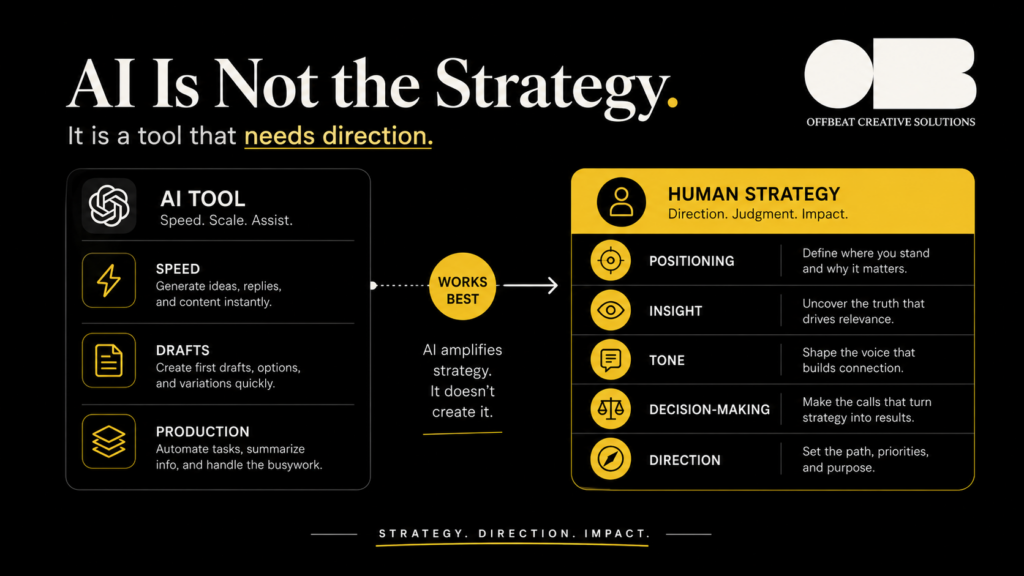
AI is not the strategy.
AI is not the brand voice.
AI is not the positioning.
AI is not the creative director.
AI is not the customer insight.
AI is a tool.
And like any tool, its value depends on how it is used.
A strong team can use AI to move faster.
A weak strategy can use AI to create more confusion.
How Brands Should Use AI in Content Marketing
Brands should use AI as part of a structured content process.
A strong process may look like this:
First, define the business goal.
Then define the audience.
Then define the content pillar.
Then define the key message.
Then use AI to create options.
Then edit the output based on brand voice, insight, and creative judgment.
Then publish.
Then measure.
Then improve.
This process keeps AI useful without letting it control the strategy.
Questions to Ask Before Publishing AI Content
Before publishing AI-generated content, ask:
Does this sound like our brand?
Is the message specific or generic?
Does it support one of our content pillars?
Does it say something our audience actually cares about?
Does it include a real insight?
Does it match our positioning?
Is the CTA clear?
Would our competitors be able to say the exact same thing?
Does this content build trust, clarity, or conversion?
If the answer is no, the content needs more human work.
AI and Human Creativity Should Work Together
The strongest approach is not AI versus humans.
It is AI plus humans.
AI can support speed.
Humans provide direction.
AI can create options.
Humans choose what matters.
AI can organize information.
Humans add insight.
AI can write a draft.
Humans make it brand-specific.
AI can help scale production.
Humans protect quality.
When both work together properly, content becomes faster without becoming empty.
The Offbeat Approach
At Offbeat Creative Solutions, we believe AI can be a useful tool in the content process.
But we also believe that strong brand marketing cannot depend on AI alone.
Before creating content, we focus on the brand’s positioning, audience, content pillars, tone of voice, creative direction, and business goal.
Then tools can help speed up execution.
Because the goal is not simply to create content faster.
The goal is to create content that supports brand clarity, trust, and growth.
AI can help produce.
But strategy decides what should be produced.
Final Thoughts
AI content is not enough for brand marketing on its own.
It can support the process.
It can speed up writing.
It can help with ideas.
It can make execution easier.
But brand marketing still needs human thinking.
It needs insight.
It needs positioning.
It needs taste.
It needs judgment.
It needs strategy.
It needs a clear understanding of the audience.
AI can help you create faster.
But faster does not always mean better.
Better comes from knowing what to say, who to say it to, and why it matters.