Why AI-Generated Content Looks Good but Often Fails
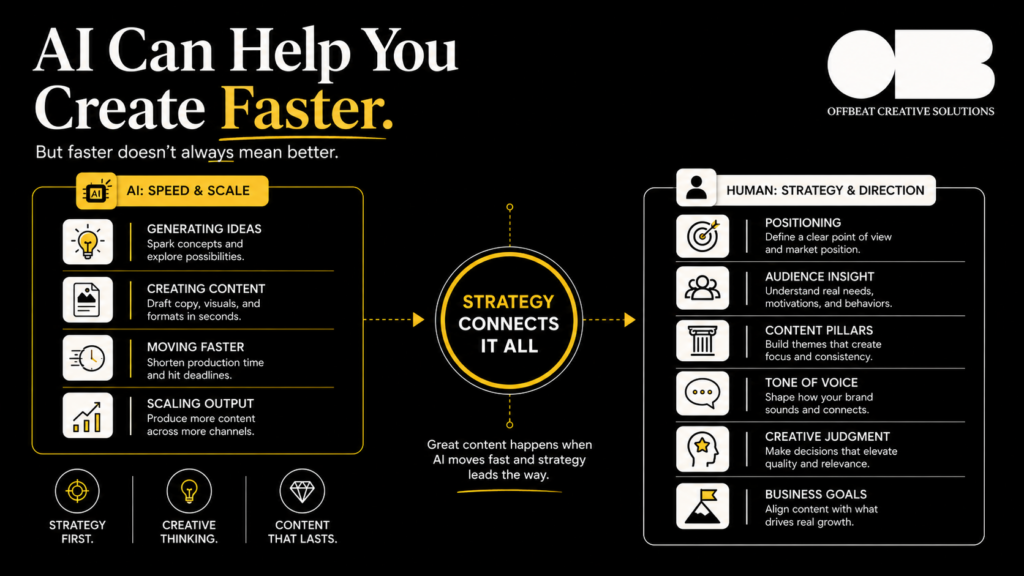
AI can help you create faster.
But faster does not always mean better.
Today, many brands use AI tools to write captions, generate ideas, create article drafts, suggest campaign concepts, and speed up content production.
And in many cases, AI can be useful.
It can save time.
It can organize thoughts.
It can suggest angles.
It can help with first drafts.
It can support brainstorming.
But AI-generated content often has one major problem:
It can look good on the surface while missing the strategic thinking that makes content actually work.
The words may be polished.
The structure may be clean.
The tone may sound professional.
But the content may still feel generic, forgettable, and disconnected from the brand.
That is why AI should not replace strategy.
It should support it.
AI Speeds Up Execution, Not Strategic Thinking
One of the biggest misconceptions about AI content is that speed equals quality.
A brand may use AI to create many posts quickly.
More captions.
More articles.
More ideas.
More scripts.
More social media content.
But producing more content does not automatically create better marketing.
The real question is not:
“How fast can we create content?”
The real question is:
“Does this content support the brand’s position, message, audience, and business goal?”
AI can help with execution, but it does not automatically understand your business context.
It does not fully know your market, your customer psychology, your sales process, your competitor gaps, your brand tone, or the reason your audience should choose you.
Without human direction, AI content can become fast but shallow.
Generic Content Makes Brands Sound the Same
AI tools are trained on patterns.
That means they are good at producing content that sounds familiar, polished, and generally acceptable.
But this can also become a problem.
If many brands are using similar prompts, similar tools, and similar structures, their content may start to sound the same.
The result is generic content.
Generic content usually includes broad phrases like:
“We help your brand grow.”
“Take your business to the next level.”
“Stand out from the competition.”
“Build a strong online presence.”
“Create content that connects.”
These lines are not always wrong.
But they are often too broad to create a clear brand difference.
If your competitors can say the exact same thing, your message is not strong enough.
Good content should not only sound nice.
It should make the brand easier to understand, remember, and choose.
AI Does Not Automatically Know Your Positioning
Brand positioning is the space your brand wants to own in the mind of the audience.
It defines how people should understand you compared to other options.
Are you the strategic agency?
The creative agency?
The performance-focused agency?
The premium option?
The practical option?
The niche expert?
The fast execution partner?
The business-first marketing partner?
AI does not automatically know this.
If you ask AI to write content without a clear positioning direction, it may produce something that sounds professional but does not strengthen the brand’s identity.
This is why prompting is not enough.
The brand needs strategic clarity before using AI.
AI can help express a message.
But the brand must define the message first.
AI Content Needs Human Insight
Good marketing content usually comes from insight.
An insight is a real understanding of what the audience thinks, feels, fears, wants, misunderstands, or needs before making a decision.
For example:
A business owner may not need “more content.”
They may need content that makes their offer easier to understand.
A brand may not need “better designs.”
It may need a clearer USP before visual identity.
A campaign may not need “more budget.”
It may need a stronger message and better creative testing.
These are strategic insights.
AI can help turn insights into content, but it does not always discover the strongest insight by itself.
The best content often comes from experience, market observation, client conversations, sales feedback, and creative judgment.
That is where human thinking becomes essential.
AI Can Miss Brand Voice
Brand voice is not only about sounding formal, friendly, bold, or premium.
It is about how the brand thinks and speaks consistently.
A strong brand voice reflects:
The brand’s personality
The audience’s language
The level of expertise
The emotional tone
The market position
The kind of relationship the brand wants to build
AI can imitate tone, but it can also flatten it.
Without editing, AI content may sound too polished, too safe, too generic, or too similar to everyone else.
A brand voice should feel intentional.
It should be shaped by the brand’s strategy, not only by a prompt.
AI Content Can Lack Creative Judgment
Creative judgment is the ability to know what to keep, what to remove, what to simplify, what to sharpen, and what to avoid.
This matters because not every content idea is worth publishing.
Some ideas are too generic.
Some are off-brand.
Some are too complicated.
Some sound good but do not support the goal.
Some are trendy but irrelevant.
Some are clear but not interesting.
Some are interesting but not useful.
AI can generate options.
But someone still needs to judge which option is strategically right.
The strongest content usually comes from a mix of AI support and human decision-making.
AI Should Be a Tool, Not the Strategy
AI is useful when it is used correctly.
It can help with:
Brainstorming topics
Creating first drafts
Organizing article structures
Generating caption variations
Summarizing ideas
Rewriting content
Creating FAQ drafts
Finding new angles
Speeding up repetitive tasks
But AI should not decide the full brand strategy.
It should not replace audience research.
It should not replace brand positioning.
It should not replace creative direction.
It should not replace content pillars.
It should not replace human judgment.
AI is powerful when the strategy is already clear.
Without strategy, it may only help you create more average content faster.
What Makes AI Content Work Better?
AI content works better when it is guided by a clear content strategy.
Before using AI, the brand should define:
Who the content is for
What the audience needs to understand
What the brand wants to be known for
What content pillar the piece belongs to
What business goal the content supports
What tone of voice should be used
What proof or insight should be included
What action the audience should take next
When these elements are clear, AI becomes more useful.
It can help create drafts faster, but the human team still shapes the final message.
The Offbeat Approach
At Offbeat Creative Solutions, we do not see AI as the enemy of creativity.
We see it as a tool.
But tools need direction.
A camera does not create a campaign by itself.
A design software does not create a brand strategy by itself.
An AI tool does not create strong marketing by itself.
The value comes from how the tool is used.
That is why we believe AI content should be guided by strategy, positioning, creative judgment, and audience understanding.
Because content should not only be fast.
It should be clear, relevant, useful, and connected to the brand’s bigger direction.
Final Thoughts
AI can help brands create faster.
But faster does not always mean better.
If AI content is not guided by strategy, it can become generic, forgettable, and disconnected from the brand.
Strong content still needs human thinking.
It needs positioning.
It needs insight.
It needs creative judgment.
It needs audience understanding.
It needs a clear brand message.
AI can support the process.
But strategy should lead it.
Because the goal is not to create more content.
The goal is to create content that actually means something.