Why Random Content Creates Random Results
Many brands do not have a content problem.
They have a direction problem.
They post regularly. They create visuals. They follow trends. They share offers. They publish tips. They try to stay active.
But their audience still does not clearly understand what the brand stands for, what it offers, why it is different, or why it should be trusted.
This is the danger of random content.
Random content can make your page look alive, but it does not always make your brand stronger.
It may create activity without clarity.
It may create reach without recognition.
It may create engagement without trust.
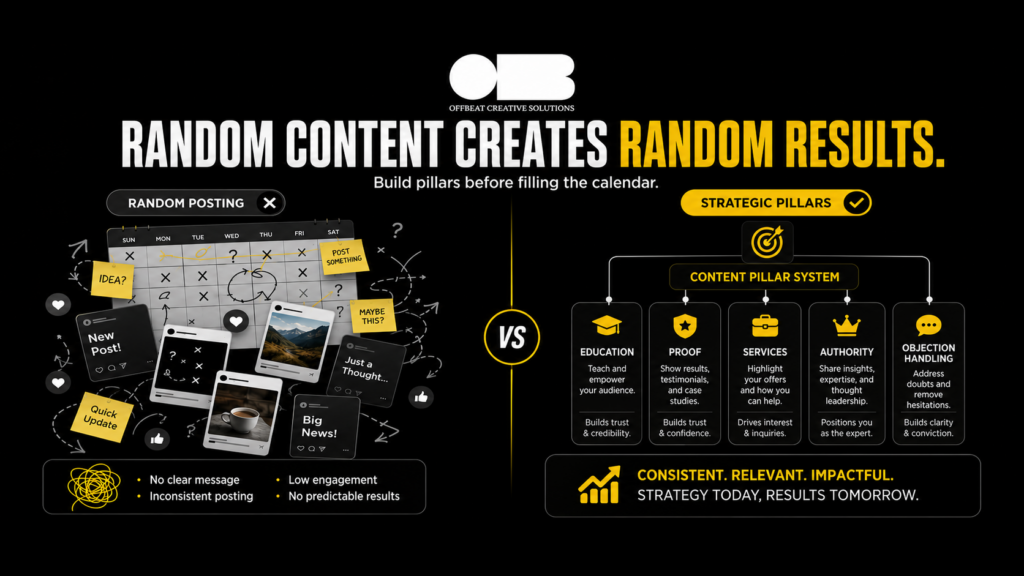
And when content is random, results often become random too.
Random Content Weakens the Brand Message
Your audience does not remember every post you publish.
They remember patterns.
They remember repeated ideas.
They remember consistent messages.
They remember how your brand makes them feel and what they believe your brand can help them with.
If every post communicates a different idea, your audience may struggle to understand your position.
One day your brand talks about discounts.
The next day it posts a trend.
Then it shares a generic tip.
Then it publishes a random quote.
Then it posts a service announcement.
None of these are automatically wrong.
The problem happens when they are not connected by a clear strategy.
Without content pillars, your brand may sound different every week.
That makes it harder for people to remember you.
A Full Calendar Is Not Always a Strong Strategy
A content calendar can be full and still be weak.
A calendar tells you what to post and when.
But it does not automatically explain why each post matters.
A strong content strategy should define:
Who the content is for
What message the brand wants to own
What content pillars guide the calendar
What business goal each pillar supports
What role each post plays in the customer journey
How performance will be measured
Without this thinking, a calendar becomes a scheduling tool, not a strategy.
It helps the brand stay active, but it does not always help the brand become clearer.
Random Content Confuses the Audience
People follow brands when they understand what value they get from them.
If your content is too scattered, your audience may not know what to expect.
They may ask:
What does this brand actually do?
Who is this for?
Why should I care?
What makes this brand different?
Why should I trust them?
What action should I take next?
When these questions are not answered consistently, people may scroll past the content even if the design looks good.
Clarity is one of the most important parts of content marketing.
If your audience does not understand your brand, they are less likely to trust it.
And if they do not trust it, they are less likely to buy.
Content Pillars Create Consistency
Content pillars help solve this problem.
They create a clear structure for what your brand talks about.
Instead of posting random ideas, your brand repeats specific themes that support its positioning.
For example, a marketing agency may use pillars such as:
Strategy education
Media buying insights
Content planning
Case studies
Branding mistakes
Marketing ROI
SEO and GEO
Social media strategy
These topics are not random.
They support the agency’s position as a strategic marketing partner.
When repeated consistently, they help the audience understand what the agency knows, what it does, and how it thinks.
Consistency builds recognition.
Recognition builds trust.
Trust supports sales.
Repetition Is Not Boring When It Has Purpose
Some brands avoid repeating ideas because they think repetition is boring.
But repetition is how brands become memorable.
Your audience does not see every post.
Even if they do, they may not remember your message the first time.
That is why important ideas need to be repeated in different formats.
One message can become:
A short post
A carousel
A reel
A case study
A website article
A LinkedIn post
A Google Business post
A Quora answer
A Reddit answer
A newsletter section
The message stays consistent.
The format changes.
This is how content pillars help your brand repeat the same strategic ideas without sounding repetitive.
Random Content Makes Measurement Harder
When your content is random, performance becomes harder to understand.
If every post has a different purpose, tone, topic, and audience, it becomes difficult to know what is actually working.
You may get high engagement on one random post, but that does not mean it supports the business.
You may get low likes on a proof post, but it may help convert serious buyers.
Content pillars make measurement clearer because each pillar has a role.
Educational content may be measured by saves and shares.
Proof content may be measured by trust and inquiries.
Service content may be measured by clicks and DMs.
Authority content may be measured by engagement quality and profile visits.
Conversion content may be measured by leads and sales.
When pillars are clear, reporting becomes smarter.
You stop asking only, “Which post got the most likes?”
You start asking, “Which pillar is helping the business move forward?”
Random Content Often Comes From Reactive Marketing
Many brands create random content because they react to the week instead of following a system.
A trend appears, so they copy it.
A competitor posts something, so they respond.
A product needs pushing, so they promote it.
A gap appears in the calendar, so they fill it quickly.
Again, none of these actions are always wrong.
But without a strategy, the brand becomes reactive.
Reactive content can make the brand lose direction.
A strong content system allows flexibility, but it does not lose the main message.
You can still follow trends.
You can still post offers.
You can still react to moments.
But those posts should fit inside a bigger direction.
Content Pillars Help Teams Work Better
Content pillars are not only useful for the audience.
They also help internal teams.
A clear pillar system helps writers, designers, account managers, media buyers, and business owners work with the same direction.
The writer knows what message to communicate.
The designer knows what type of visual direction supports the content.
The account manager knows why the content exists.
The media buyer knows which messages can be tested.
The business owner understands how content connects to the brand goal.
Without pillars, everyone may work from personal taste or last-minute ideas.
With pillars, the team works from a shared strategy.
How to Replace Random Content With a Pillar System
To move away from random content, start with these steps:
1. Define the brand position
What do you want the brand to be known for?
2. Understand the audience
What questions, problems, and objections does the audience have?
3. Choose 4 to 6 core pillars
Pick themes that support the brand message and business goals.
4. Give each pillar a role
Decide whether each pillar builds awareness, trust, authority, proof, or conversion.
5. Create post ideas under each pillar
Turn each pillar into multiple content ideas.
6. Build a balanced calendar
Make sure each month includes a healthy mix of pillars.
7. Measure pillar performance
Track how each pillar contributes to the customer journey.
This turns content planning into a system.
The Offbeat Approach
At Offbeat Creative Solutions, we believe content should not exist just to fill a calendar.
It should help the brand become clearer, more trusted, and more valuable to the right audience.
That is why we build content strategies around business goals, audience segments, brand positioning, and content pillars.
We do not only ask what should be posted.
We ask:
What should the audience understand?
What should they trust?
What should they remember?
What should they do next?
Which pillar supports that goal?
This is how content becomes more than social media activity.
It becomes a structured system for brand growth.
Final Thoughts
Posting randomly may keep your page active.
But it will not always make your brand stronger.
If your audience sees your content but still does not understand what your brand stands for, the problem may not be posting frequency.
The problem may be a lack of content pillars.
Clear pillars help your brand repeat the right messages.
They help your audience understand you faster.
They help your team plan smarter.
They help your content support trust, leads, and sales.
Random content creates random results.
But strategic content creates direction.
And direction is what helps a brand become easier to understand, remember, and choose.
FAQ
Why is random content bad for branding?
Random content is bad for branding because it can confuse the audience, weaken the brand message, and make it harder for people to remember what the brand stands for.
How do content pillars improve social media?
Content pillars improve social media by creating consistency, organizing topics, guiding the content calendar, and connecting posts to business objectives.
Can a brand post trends and still have content pillars?
Yes. A brand can post trends as long as they fit within the brand’s message, audience, and content pillars.
How do I know if my content is random?
Your content may be random if your posts do not support a clear message, your audience does not understand what you offer, or your calendar is full but lacks direction.
How can I stop posting random content?
Start by defining your brand position, understanding your audience, choosing 4 to 6 content pillars, giving each pillar a role, and planning posts around those pillars.