Why Marketing Should Start With a Business Diagnosis
Many brands want to start marketing immediately.
They want posts.
They want ads.
They want designs.
They want reels.
They want campaigns.
They want a better-looking online presence.
And these things matter.
But they should not be the first step.
Before a brand starts creating content, running ads, changing visuals, or launching campaigns, it needs to understand what is actually happening inside the business.
Because sometimes the problem is not marketing execution.
Sometimes the problem is the offer.
Sometimes it is the audience.
Sometimes it is the customer journey.
Sometimes it is the sales process.
Sometimes it is the message.
And if these problems are not diagnosed first, marketing can become a faster way to spend money without solving the real issue.
Marketing should start with a business diagnosis.
Marketing Execution Is Not Always the Solution
It is easy to assume that a brand needs more marketing when results are weak.
If leads are low, the brand may ask for ads.
If engagement is low, the brand may ask for more content.
If sales are slow, the brand may ask for a campaign.
If the page looks outdated, the brand may ask for new designs.
But better execution does not always fix a deeper business problem.
More content will not fix an unclear offer.
More ads will not fix a weak landing page.
Better visuals will not fix confusing positioning.
A new campaign will not fix a poor sales follow-up process.
Marketing execution can amplify what is already working.
But it cannot replace business clarity.
What Is a Business Diagnosis?
A business diagnosis is the process of understanding the current state of the brand before deciding what marketing actions should happen.
It looks at the full picture.
Not only the social media page.
Not only the ad account.
Not only the website design.
A proper diagnosis looks at:
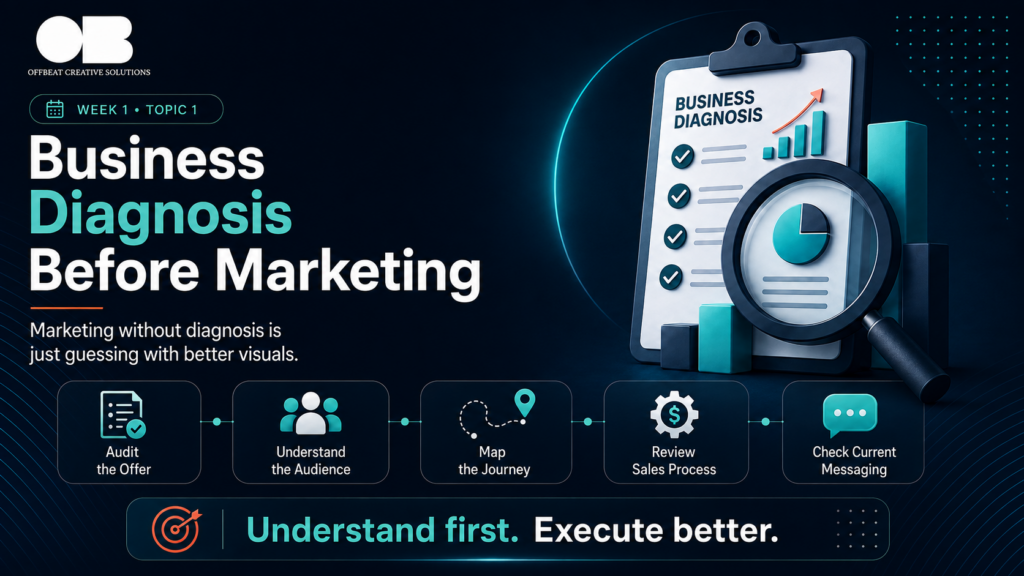
The offer
The audience
The customer journey
The sales process
The current messaging
The content direction
The website experience
The trust signals
The conversion points
The business goals
The goal is simple:
To understand what is stopping the brand from growing before choosing what to execute.
Diagnose the Offer First
A weak offer can make even a strong campaign fail.
An offer is not only a discount.
It is the value the customer is being asked to respond to.
Before marketing starts, the brand should ask:
Is the offer clear?
Is the value easy to understand?
Is the offer relevant to the audience?
Is the next step simple?
Is there a reason to act now?
Does the offer match the customer’s level of awareness?
If the offer is weak or unclear, marketing may bring attention but not action.
People may see the content.
They may click the ad.
They may visit the page.
But they may not convert because the offer does not feel strong enough.
Understand the Audience Before Speaking to Them
Marketing depends on understanding people.
Before creating posts or ads, the brand needs to know who it is speaking to.
Different audiences have different problems, expectations, objections, and motivations.
A business owner may care about ROI.
A marketing manager may care about performance reports.
A startup founder may care about speed and clarity.
A premium client may care about trust, quality, and positioning.
If the audience is not clear, the message becomes generic.
And generic messages rarely build strong trust.
A good diagnosis asks:
Who is the real target audience?
What problem are they trying to solve?
What makes them hesitate?
What do they compare us with?
What do they need to believe before taking action?
What language do they use when describing their problem?
Marketing should not start by asking, “What should we post?”
It should start by asking, “Who are we talking to, and what do they need to understand?”
Map the Customer Journey
Many marketing problems happen because the customer journey is broken.
A person may see an ad, then visit the website, then check social media, then look for proof, then send a message, then wait for a response.
Every step matters.
If one step is weak, the whole journey can lose performance.
For example:
The ad may be strong, but the landing page is unclear.
The content may be good, but the offer is weak.
The website may look nice, but it does not explain the value.
The lead may be interested, but the sales response is slow.
The brand may get attention, but there is not enough proof.
A business diagnosis helps identify where people are dropping off.
Without this step, the brand may keep changing creatives and captions while the real problem happens after the click.
Review the Sales Process
Marketing and sales are connected.
If the sales process is weak, marketing performance may look weaker than it really is.
A campaign can generate leads, but if the follow-up is slow or unclear, those leads may not convert.
Before launching more marketing, the business should ask:
How fast does the team respond to leads?
Are leads being qualified properly?
Does the sales team understand the campaign message?
Are objections being recorded?
Are lost leads being analyzed?
Is sales feedback shared with marketing?
Sometimes the problem is not lead generation.
It is lead handling.
Marketing should not operate separately from sales.
A strong diagnosis connects both.
Audit the Current Messaging
Messaging is one of the most important parts of marketing.
A brand may have a good service, good team, and good visuals, but if the message is unclear, people may not understand why they should choose it.
A messaging audit looks at:
What the brand says
How it explains its value
Whether the message is specific or generic
Whether the audience understands the offer
Whether the message is consistent across platforms
Whether the brand sounds different from competitors
Many brands say things like:
“We help your business grow.”
“We create creative solutions.”
“We take your brand to the next level.”
These lines may sound good, but they are not always specific enough.
If competitors can say the same thing, the message needs work.
Separate Marketing Symptoms From Business Problems
This is one of the most important parts of diagnosis.
A symptom is what you see.
A problem is what causes it.
For example:
Low engagement may be a symptom.
Unclear audience relevance may be the real problem.
Low leads may be a symptom.
A weak offer may be the real problem.
High traffic but no conversion may be a symptom.
A poor landing page may be the real problem.
Low sales may be a symptom.
Slow follow-up may be the real problem.
Without diagnosis, the brand may treat symptoms and ignore causes.
That leads to random execution.
The Offbeat Approach
At Offbeat Creative Solutions, we believe marketing should start before execution.
We do not begin by asking only what designs, posts, or ads are needed.
We start by understanding the business.
We look at the offer, audience, message, customer journey, sales process, content direction, and conversion points.
Because our goal is not only to make brands visible.
Our goal is to make them make sense.
When the diagnosis is clear, the strategy becomes sharper.
When the strategy is sharper, execution becomes stronger.
And when execution is connected to business reality, marketing becomes more than activity.
It becomes a growth system.
Final Thoughts
Marketing without diagnosis is guessing with better visuals.
A brand should not jump straight into execution before understanding what needs to be fixed.
Before posting, diagnose the message.
Before running ads, diagnose the offer.
Before redesigning, diagnose the positioning.
Before scaling, diagnose the customer journey.
Because strong marketing does not start with more activity.
It starts with better understanding.