How Marketing Becomes Soft Sales When the Brand Journey Makes Sense
Marketing should not only create awareness.
It should make sales easier.
When marketing is built correctly, it helps the audience understand the brand before they speak to the sales team.
It answers questions.
It builds trust.
It shows proof.
It explains value.
It reduces hesitation.
It prepares the customer to take the next step.
This is what we mean when we say marketing can become soft sales.
Not aggressive selling.
Not constant promotion.
Not pushing offers every day.
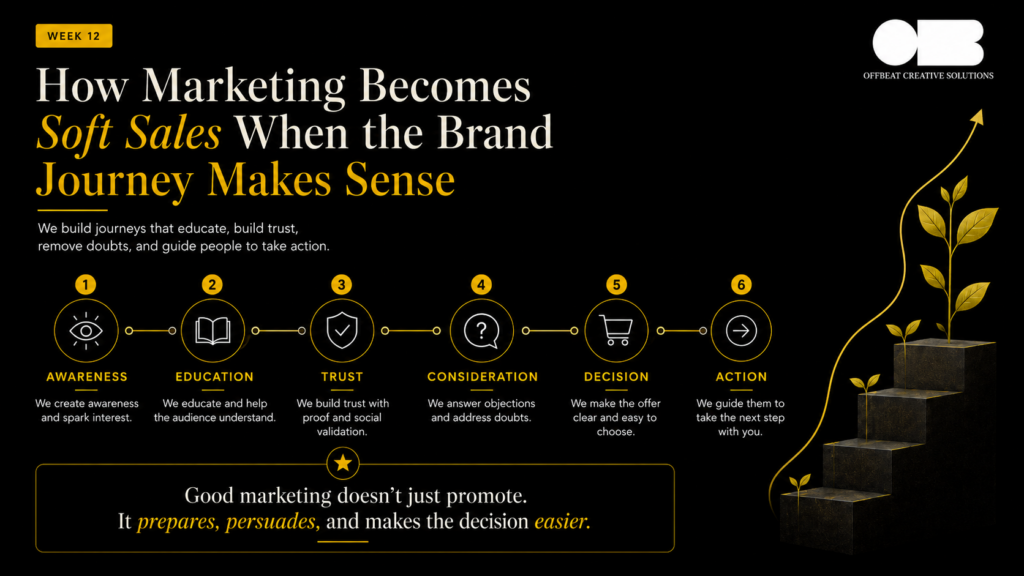
But creating a brand journey that helps people move from confusion to clarity, from awareness to trust, and from interest to action.
Sales Starts Before the Sales Call
Many businesses think sales begins when a customer sends a message, fills a form, or books a call.
But in reality, sales begins much earlier.
It starts when the customer first sees the brand.
They may see a post, an ad, a website page, a review, a case study, a Google Business post, or a LinkedIn article.
Before contacting the business, they may already be asking:
Do I understand what this brand does?
Does this brand seem credible?
Do they understand my problem?
Have they solved similar problems before?
Is their offer relevant to me?
Do I trust them enough to take the next step?
Marketing should help answer these questions.
When it does, the sales process becomes easier.
Clarity Reduces Friction
A confused customer does not convert easily.
If the brand message is unclear, people hesitate.
If the service is not explained well, people delay.
If the offer is vague, people compare more.
If the website is confusing, people leave.
Clarity is one of the strongest ways marketing can support sales.
Good marketing should make it easy for the audience to understand:
What you do
Who you help
What problem you solve
Why your approach matters
What makes you different
What the next step is
When the message is clear, the customer needs less explanation later.
That is soft sales.
Content Builds Trust Before the Conversation
Trust is not built from one ad or one post.
It is built through repeated signals.
Educational content shows that the brand understands the problem.
Proof content shows that the brand can deliver.
Case studies show experience.
Behind-the-scenes content shows process and people.
Authority content shows perspective.
Objection-handling content reduces doubts.
Service content explains the offer.
Together, these content types prepare the audience.
By the time a customer contacts the brand, they may already understand the value.
This makes the sales conversation more qualified and more focused.
Positioning Helps the Customer Choose
People do not only choose based on what you offer.
They choose based on how they understand you compared to other options.
Positioning helps the customer answer:
Why this brand?
Why not another agency?
Why is this approach better for me?
A brand with weak positioning may receive inquiries, but the sales conversation becomes harder because the customer does not understand the difference.
A brand with strong positioning creates preference before the sales conversation begins.
That means the customer is not only asking for price.
They are already interested in the approach.
Marketing Should Answer Objections Early
Every customer has objections.
Is this worth the cost?
Will this work for my business?
Why should I trust this team?
What makes them different?
Will they understand my market?
How do they work?
What results can I expect?
If marketing does not answer these objections, sales has to handle all of them later.
But when content answers objections early, the customer becomes more prepared.
For example:
An article can explain why strategy comes before execution.
A case study can show how the agency solves real problems.
A post can explain why ads alone are not enough.
A service page can clarify what is included.
A Google Business post can strengthen trust.
A LinkedIn article can build authority.
This is how content supports sales without feeling like direct selling.
The Website Is Part of the Sales Team
A website should not only exist as a digital profile.
It should help move the customer closer to action.
A strong website explains the brand clearly, organizes services, shows proof, answers questions, and gives people a clear next step.
If the website is weak, the sales journey becomes harder.
People may visit but not understand.
They may be interested but not convinced.
They may want to contact you but not know what to do next.
The website should work like a quiet salesperson.
It should explain, guide, reassure, and convert.
Ads Bring People Into the Journey
Paid ads can bring attention.
But attention is only valuable if the journey behind it is ready.
If someone clicks an ad and finds a weak landing page, unclear offer, or no proof, the campaign may lose them.
But if the ad connects to strong content, a clear website, a strong offer, and a smooth sales process, the campaign becomes more powerful.
Ads should not work alone.
They should bring people into a journey that already makes sense.
Sales and Marketing Should Share Feedback
Marketing becomes stronger when it listens to sales.
Sales teams hear the real questions, doubts, objections, and hesitations from customers.
That information should improve marketing.
If customers keep asking the same question, it should become content.
If leads misunderstand the service, the messaging should be clearer.
If people hesitate because of trust, more proof is needed.
If the offer is confusing, the landing page should be improved.
When marketing and sales work together, the whole journey becomes stronger.
The Offbeat Approach
At Offbeat Creative Solutions, we see marketing as more than visibility.
We build marketing systems that support the full brand journey.
That includes strategy, positioning, messaging, content pillars, website structure, ads, creative direction, and sales alignment.
Our goal is not only to attract attention.
Our goal is to make the brand make sense before the customer takes action.
Because when the journey makes sense, marketing becomes soft sales.
It helps people understand.
It helps people trust.
It helps people choose.
Final Thoughts
Marketing should not only bring people to the brand.
It should help them move through the decision.
When content builds trust, positioning creates preference, the website explains value, ads bring relevant attention, and sales follows up properly, the whole journey becomes stronger.
That is when marketing becomes more than activity.
It becomes a business development system.
And that is the difference between making a brand visible and making a brand make sense.