Why Strategy Comes Before Marketing Execution
Execution is important.
A brand needs designs, posts, reels, ads, websites, campaigns, articles, and visuals.
But execution without strategy often creates activity without direction.
Many businesses move too quickly into execution.
They ask for content before defining the message.
They ask for ads before fixing the offer.
They ask for designs before clarifying the positioning.
They ask for a website before mapping the customer journey.
The result is marketing that looks active but does not always support business growth.
That is why strategy should come before execution.
Execution Shows the Message
Every marketing asset communicates something.
A social media post communicates what the brand cares about.
An ad communicates what the brand wants people to notice.
A website communicates how the brand wants to be understood.
A campaign communicates what the audience should do next.
If the strategy is unclear, the execution becomes unclear too.
The designs may look good, but the message may be weak.
The ads may get clicks, but the audience may not convert.
The website may look modern, but visitors may still not understand why they should choose the brand.
Execution can express strategy.
But it cannot replace it.
Strategy Defines the Direction
Marketing strategy answers the questions that guide execution.
Who are we speaking to?
What do they need?
What do they misunderstand?
What problem are we solving?
What makes the brand different?
What message should we repeat?
What action do we want the audience to take?
How will we measure success?
Without these answers, every piece of content becomes a guess.
The team may create posts based on trends, personal taste, competitor activity, or last-minute ideas.
That may keep the page active, but it does not build a strong brand.
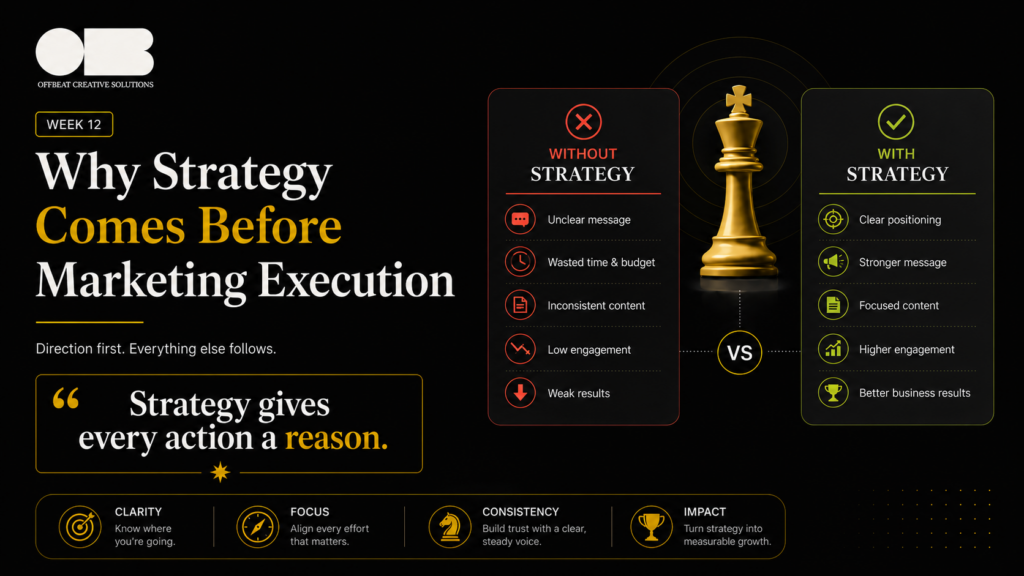
Strategy gives every marketing action a reason.
Audience Understanding Comes First
Before choosing content formats, campaign ideas, or visual directions, the brand needs to understand the audience.
Different audiences need different messages.
A customer who does not know the brand needs awareness.
A customer comparing options needs proof.
A customer who is interested but hesitant needs objection handling.
A customer ready to buy needs a clear offer and call to action.
When the audience journey is ignored, content becomes one-size-fits-all.
But people do not make decisions at the same stage.
Strong strategy helps the brand say the right thing at the right time.
Positioning Makes Execution Stronger
Positioning defines how the brand should be understood compared to competitors.
It gives the brand a clear place in the market.
Without positioning, execution becomes generic.
The brand may use nice visuals, trendy captions, and polished ads, but the audience still may not know why this brand matters.
Strong positioning improves:
Content direction
Ad messaging
Website structure
Brand identity
Sales conversations
Creative concepts
Campaign ideas
A well-positioned brand is easier to explain.
And a brand that is easier to explain is easier to sell.
Messaging Turns Strategy Into Communication
Messaging is the bridge between strategy and execution.
It turns business thinking into words the audience can understand.
A strong message should explain:
What the brand does
Who it helps
What problem it solves
Why it is different
Why people should trust it
What action they should take next
Without clear messaging, marketing can become visually strong but commercially weak.
The audience may like the content, but not understand the value.
The goal is not only to sound good.
The goal is to make the brand clear.
Content Pillars Organize Execution
Once the strategy is clear, content pillars help organize execution.
Content pillars define the main themes the brand should talk about consistently.
For example:
Education
Proof
Services
Authority
Behind the scenes
Objection handling
Conversion
These pillars help the brand avoid random posting.
They create a structure for the content calendar.
Each post has a role.
Some posts build awareness.
Some build trust.
Some explain services.
Some answer doubts.
Some support sales.
This is how strategy becomes daily content.
Ads Need Strategy Too
Media buying is not only about targeting and budget.
Ads need a strong message, clear offer, creative testing, landing page alignment, and proper reporting.
If the strategy behind the campaign is weak, ads may spend money without producing meaningful results.
Before launching ads, the brand should know:
Who is the audience?
What is the offer?
What problem does the ad address?
What landing page will the user visit?
What proof supports the message?
What result are we measuring?
Ads work best when they amplify a strong system.
They do not work well when they are used to cover strategic gaps.
The Offbeat Approach
At Offbeat Creative Solutions, we believe execution should be built on strategy.
We do not start with “what should we post?”
We start with:
What is the business trying to achieve?
Who are we speaking to?
What should the audience understand?
What should the brand be known for?
What is stopping people from taking action?
How can marketing support growth?
Then we turn that thinking into content, designs, campaigns, ads, website structure, and creative direction.
Because execution matters.
But direction matters first.
Final Thoughts
Marketing execution without strategy may create activity.
But activity is not the same as growth.
A brand does not need more random posts, more disconnected ads, or more designs without direction.
It needs a clear system.
Strategy gives execution meaning.
Positioning gives the brand a place.
Messaging gives the audience clarity.
Content pillars give the calendar structure.
And execution brings the strategy to life.
That is why strategy comes before marketing execution.