Why Your Brand Needs More Than Ads to Grow
Paid ads can bring traffic.
They can put your brand in front of more people, generate clicks, increase reach, and create new opportunities.
But ads alone do not guarantee growth.
Many businesses invest in advertising expecting immediate results. They increase budgets, test audiences, change creatives, and launch more campaigns.
But even with more traffic, the business may still struggle to generate qualified leads, sales, or long-term growth.
Why?
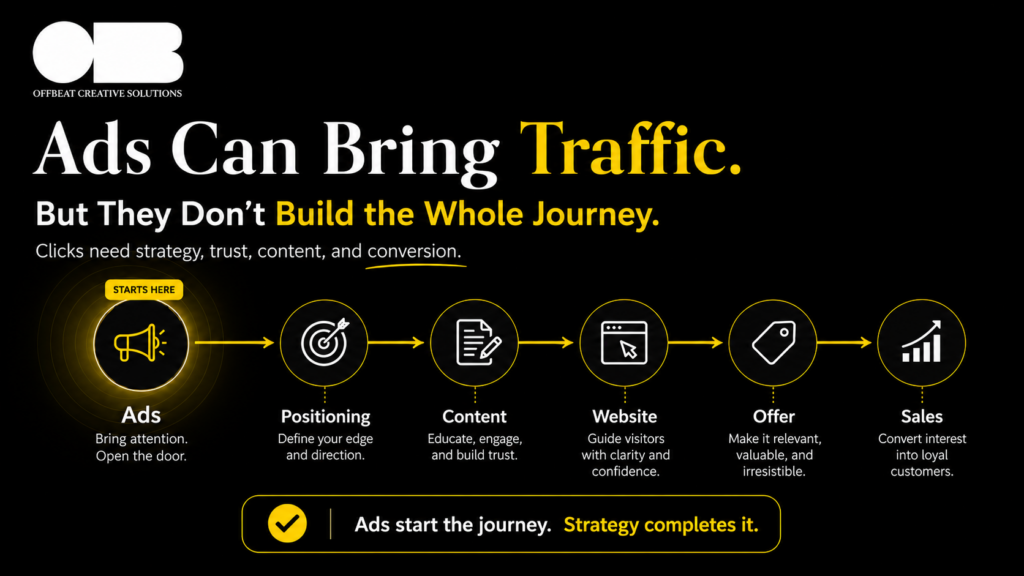
Because ads are only one part of the customer journey.
They can bring attention, but they do not build the full experience that turns attention into trust and action.
If the brand message is unclear, the offer is weak, the landing page is confusing, or the sales process is slow, paid ads may only expose the problem faster.
Ads can amplify a strong brand journey.
But they cannot replace one.
Ads Bring Attention, Not Guaranteed Growth
A successful ad can make people stop scrolling.
It can make them click, visit a page, send a message, or submit a form.
But what happens after that?
That is where many campaigns lose performance.
A click does not mean the customer is convinced.
A form submission does not mean the lead is qualified.
A high reach does not mean the brand is trusted.
Paid ads can start the conversation, but the rest of the journey must continue it.
The audience still needs to understand:
What does this brand offer?
Why is it different?
Why should I trust it?
Is the offer relevant to me?
What proof supports the claim?
What should I do next?
If the rest of the journey does not answer these questions clearly, the campaign may spend money without creating real business growth.
Traffic Is Not the Same as Trust
One of the biggest mistakes businesses make is confusing traffic with trust.
Traffic means people arrived.
Trust means they are willing to move forward.
A campaign can bring thousands of visitors to a landing page, but if the brand does not feel credible, those visitors may leave.
Trust is built through clear messaging, professional presentation, useful content, proof, testimonials, case studies, reviews, strong design, and a smooth customer experience.
This is especially important for service-based businesses, high-ticket offers, B2B companies, real estate, healthcare, education, legal services, and marketing agencies.
The more important the buying decision, the more trust the customer needs before taking action.
Ads can introduce the brand.
But trust is built across the full journey.
A Weak Offer Wastes Ad Spend
Sometimes the ad is not the problem.
The offer is.
An offer is not only a discount or promotion. It is the value you are asking the audience to respond to.
A strong offer should be clear, relevant, specific, believable, and easy to act on.
If the offer is too vague, too broad, or not connected to a real customer need, people may click but not convert.
For example, a message like “Grow your business with us” may sound positive, but it does not explain enough.
A stronger offer explains who it is for, what problem it solves, what value it creates, and why the audience should care now.
Before blaming the campaign, the budget, or the platform, businesses should ask:
Is the offer strong enough?
Is the value clear?
Does it match the audience’s awareness level?
Is the next step simple?
Does the audience have a real reason to act?
If the offer is weak, more ad spend will not fix it.
It will only send more people toward an offer that is not ready to convert.
Landing Pages Can Make or Break Performance
The landing page is one of the most important parts of paid advertising.
The ad creates interest.
The landing page must turn that interest into action.
A strong landing page should quickly explain:
What the offer is
Who it is for
Why it matters
What makes the brand different
What proof supports the claim
What the visitor should do next
Many campaigns fail because the landing page does not match the promise of the ad.
The ad may be clear, but the page may be confusing.
The ad may attract the right audience, but the page may load slowly.
The ad may create interest, but the page may not show enough proof.
Common landing page problems include unclear headlines, weak calls to action, poor mobile experience, missing testimonials, too much text without structure, and no clear reason to trust the brand.
If the landing page is weak, the campaign will struggle even if the ad account is set up correctly.
Positioning Affects Conversion
People do not only choose based on what they see in an ad.
They choose based on how they understand the brand.
Brand positioning defines what space your business owns in the audience’s mind.
Are you the premium option?
The strategic partner?
The fast solution?
The specialist?
The creative expert?
The performance-focused agency?
The safest choice?
If positioning is unclear, the audience may see the ad but still not understand why they should choose your brand over another option.
Strong positioning helps every part of the campaign work better.
It makes the ad message sharper.
It makes the landing page clearer.
It makes the content more consistent.
It makes the sales conversation easier.
Without positioning, ads may create visibility without preference.
And visibility without preference rarely creates sustainable growth.
Content Supports the Decision
Paid ads do not work in isolation.
A customer may see your ad, then check your Instagram, LinkedIn, Google Business Profile, website, reviews, blog articles, or previous content before taking action.
This means your content ecosystem matters.
If your ad promises expertise but your content looks random, the audience may hesitate.
If your ad promotes a service but your website does not explain it clearly, people may leave.
If your ad claims results but there are no case studies, proof points, or testimonials, the promise may feel weak.
Content supports the decision before and after the click.
It helps the audience understand the brand, trust the offer, and feel more confident about taking the next step.
A strong paid ads strategy should be connected to a strong content strategy.
Sales Process Matters After the Lead
Generating a lead is not the end of the campaign.
For many businesses, the final result depends on the sales follow-up.
If the sales team responds late, uses unclear communication, does not understand the campaign promise, or fails to qualify leads properly, the campaign may appear weak even if marketing did its job.
A good sales process should include fast response time, clear follow-up, proper lead qualification, objection tracking, and feedback between sales and marketing.
The sales team should know where the lead came from, what offer they responded to, and what message they saw.
Without that alignment, leads can lose interest quickly.
Paid ads bring opportunities.
The sales process helps convert them.
The Offbeat Approach
At Offbeat Creative Solutions, we do not treat paid ads as a separate activity from the rest of the brand.
Media buying should connect with positioning, content, landing pages, offers, reporting, and sales goals.
A campaign does not succeed only because the targeting is good.
It succeeds when the full journey makes sense.
That is why we look at the complete path from the first impression to the final conversion.
We ask:
Is the message clear?
Is the offer strong?
Does the landing page build trust?
Is the content supporting the campaign?
Is the sales process ready?
Are we measuring the right results?
Because ads do not fix a broken brand journey.
They expose it faster.
Final Thoughts
Paid ads can be powerful.
But they work best when the full brand journey is ready.
Ads can bring attention, but the brand must build trust.
Ads can bring clicks, but the landing page must convert.
Ads can generate leads, but the sales process must follow up.
Ads can increase visibility, but positioning must create preference.
Before investing more in advertising, businesses should make sure the journey behind the campaign is strong enough to handle the attention.
Because growth does not happen from traffic alone.
It happens when strategy, content, website, offer, trust, and sales work together.
Ads can start the journey.
Strategy completes it.