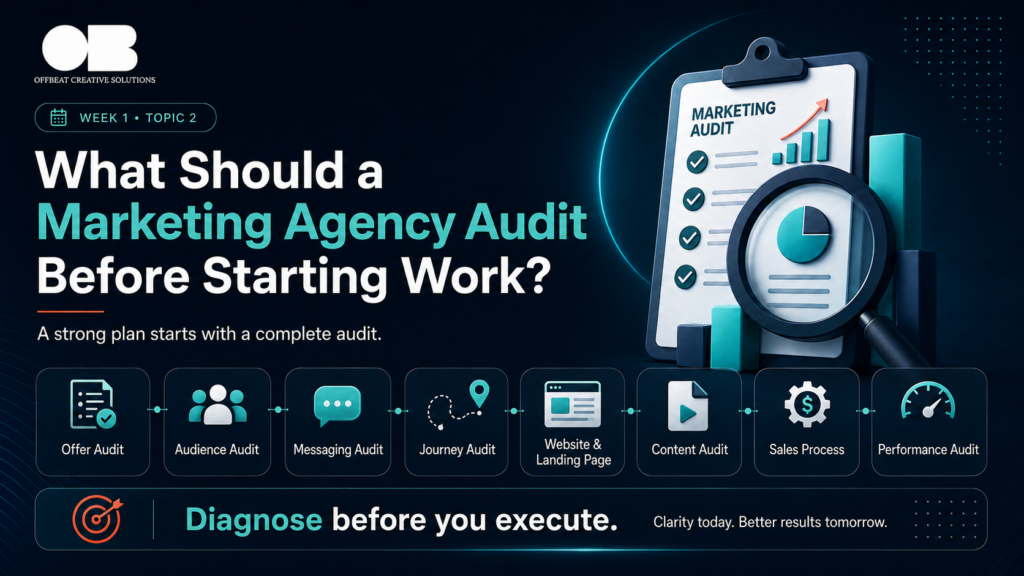
What Should a Marketing Agency Audit Before Starting Work?
Before a marketing agency starts posting, designing, advertising, or creating campaigns, it should understand the business first.
This is where many marketing relationships go wrong.
The brand asks for execution.
The agency starts execution.
Posts are created.
Ads are launched.
Reports are sent.
Designs are approved.
But a few months later, the business still asks the same question:
Why are we not getting better results?
The answer is often simple.
The agency started execution before diagnosis.
A strong marketing agency should audit the business before recommending content, ads, campaigns, or design work.
Because the right marketing plan depends on knowing what actually needs to be fixed.
The Offer Audit
The first thing to audit is the offer.
A campaign can only perform well if the offer is clear and valuable.
The agency should understand:
What is being sold?
Who is it for?
Why should the customer care?
What makes it different?
Is the value easy to understand?
Is the next step simple?
Is the offer suitable for the audience’s awareness level?
Sometimes the brand does not need more ads.
It needs a clearer offer.
If the offer is weak, vague, or too similar to competitors, marketing will struggle to create action.
The Audience Audit
Marketing without audience clarity becomes generic.
A strong agency should not only ask for age, gender, and location.
It should understand the audience’s mindset.
What does the audience want?
What problem are they trying to solve?
What makes them hesitate?
What objections do they usually have?
What content do they consume?
What language do they use?
What level of trust do they need before buying?
Audience understanding affects content, ads, website copy, landing pages, offers, and sales conversations.
If the audience is unclear, the strategy becomes unclear.
The Messaging Audit
Messaging is how the brand communicates value.
A marketing agency should audit the current message before creating new content.
This includes:
Social media bios
Website headlines
Service descriptions
Ad copy
Captions
Landing pages
Sales scripts
Google Business content
LinkedIn positioning
The agency should ask:
Is the message clear?
Is it specific?
Is it believable?
Is it consistent across platforms?
Does it explain why the brand is different?
Does it answer the audience’s main questions?
Can competitors say the same thing?
If the message is generic, even strong visuals may not convert.
The Customer Journey Audit
A customer rarely decides from one post or one ad.
They move through a journey.
They may see content, click an ad, visit the website, check reviews, compare options, send a message, and speak to sales.
A strong agency should map this journey.
Where does the audience first discover the brand?
What do they see next?
Where do they go after clicking?
What proof do they find?
How easy is it to contact the business?
What happens after they become a lead?
Where do people drop off?
This helps the agency understand whether the problem is awareness, trust, conversion, follow-up, or offer clarity.
The Website and Landing Page Audit
A website is not just a digital profile.
It is part of the conversion system.
Before launching campaigns, the agency should audit the website or landing page.
Important questions include:
Is the headline clear?
Does the page explain the offer quickly?
Is the call to action easy to find?
Is the page mobile-friendly?
Does it load fast?
Does it show proof?
Does it answer objections?
Does it match the ad message?
Does it help people trust the brand?
If the website is weak, ads may bring traffic without results.
The Content Audit
A content audit helps understand whether the brand’s current content supports the business goal.
The agency should review:
Content pillars
Post types
Visual consistency
Messaging consistency
Engagement quality
Educational content
Proof content
Service content
Objection-handling content
Conversion content
The goal is not only to see whether the page looks active.
The goal is to understand whether the content helps the audience move closer to trust and action.
A page can post often and still fail to communicate clearly.
The Sales Process Audit
Sales follow-up can affect marketing performance heavily.
A marketing agency should understand what happens after leads come in.
How fast does the team respond?
What questions do leads ask?
What objections appear often?
How are leads qualified?
What percentage of leads turn into customers?
What happens to lost leads?
Is there follow-up?
Does sales feedback return to marketing?
Without this information, marketing reports may only show part of the truth.
A campaign may generate interest, but the sales process may lose it.
The Performance Audit
Performance should not be judged only by likes, reach, or clicks.
A strong audit should review metrics that connect to business outcomes.
This may include:
Website visits
Landing page conversion rate
Lead quality
Cost per qualified lead
Sales conversion rate
Response time
Customer acquisition cost
Revenue generated
Most common objections
Drop-off points
This helps the agency understand what is actually working and what only looks good in reports.
Why This Audit Matters
An audit prevents random execution.
It helps the agency recommend the right actions instead of simply producing deliverables.
Without an audit, the agency may create content when the offer needs fixing.
It may run ads when the landing page is not ready.
It may redesign visuals when the positioning is unclear.
It may increase posting frequency when the message itself is weak.
Diagnosis saves time, budget, and effort.
The Offbeat Approach
At Offbeat Creative Solutions, we believe the first step should be understanding the business.
Before execution, we look at the offer, audience, messaging, content, customer journey, sales process, and performance signals.
This helps us separate marketing symptoms from business problems.
Because a brand may not need more posts.
It may need clearer positioning.
It may not need more ads.
It may need a stronger journey.
It may not need more activity.
It may need better direction.
Final Thoughts
A marketing agency should audit before it acts.
The goal is not to delay execution.
The goal is to make execution smarter.
When the diagnosis is clear, the work becomes more focused.
The message becomes sharper.
The content becomes more useful.
The ads become more connected.
The website becomes more effective.
And the business can make better marketing decisions.
Marketing should not start with guessing.
It should start with diagnosis.